Welcome to the Journal of Modern Literature news and information site.


Check here for updates about our latest issues, calls for papers, submission guidelines and tips, as well special online-only content. Our issues themselves are available at Project Muse and are archived on JSTOR . Check out the "Read for Free" page to enjoy some featured content.


More than four decades after its founding, the Journal of Modern Literature remains a leading scholarly journal in the field of modern and contemporary literature and is widely recognized as such. It emphasizes scholarly studies of literature in all languages, as well as related arts and cultural artifacts, from 1900 to the present. International in its scope, its contributors include scholars from Africa, Asia, Europe, North America, Oceana, and South America.

Showing posts with label Virginia Woolf. Show all posts

Thursday, September 3, 2026

BOOK NEWS: How modernist writers reading faces reconfigured physiognomy

Face and Form: Physiognomy in Literary Modernism

By Anca Parvulescu


Cambridge UP, 2025

ISBN: 9781009599801 Open Access ebook

https://www.cambridge.org/core/books/face-and-form/3C155E6711CD5D399C1F20B7DE1B2D24


Faces, faces, faces – faces everywhere! Modernism was obsessed with the ubiquity of the human face. Thomas Mann, Marcel Proust, Virginia Woolf, Gertrude Stein, and, later, Kōbō Abe framed their literary projects around the question of the face, its dynamic of legibility and opacity. 

BOOK NEWS is an online-only feature announcing new publications in modernist and contemporary literary studies. These announcements do NOT constitute an endorsement by the Journal of Modern Literature.

In literary modernism, the face functioned as a proxy for form, memory, intermediality, or difference – and combinations thereof. The old pseudo-science of physiognomy, which assumed faces to be sites of legible meaning, was in the process reconfigured. Modernist faces lost their connection to interiority, but remained surfaces of reading and interpretation. As such, they also became canvases for creative appropriation, what Mina Loy called auto-facial-construction. The modernist overinvestment in faces functions as a warning against the return of physiognomy in contemporary technologies of facial recognition. 

“Face and Form reassesses the centrality of physiognomy in the modernist perception to ask what we can learn from it today. This book is a remarkable contribution to modernist studies, and a timely response to the ongoing debates on facial recognition technologies and the politics of COVID-19.” —Katja Haustein, lecturer in Comparative Literature, University of Kent

“Face and Form: Physiognomy in Literary Modernism is an engaging, lucidly written account of the face as the site of a modernist struggle over form. Parvulescu offers brilliant re-readings of canonical modernist texts that focus on “modernist faciality” in light of their well-known experiments with character and literary form.” —Rochelle Rives, professor of English, City University of New York


Anca Pârvulescu is a scholar of comparative literature specializing in global modernism, literary and critical theory, literary comparatist, migration studies, and East Europe. She is the Liselotte Dieckmann Professor of Comparative Literature in the Department of English at the Washington University in St. Louis. Her books include Laughter: Notes on a Passion (MIT P, 2010); The Traffic in Women’s Work: East European Migration and the Making of Europe (U of Chicago P, 2014); and with Manuela Boatcă, Creolizing the Modern: Transylvania across Empires (Cornell UP, 2022).

Thursday, July 30, 2026

BOOK NEWS: An expansive and multifaceted account of the Bloomsbury Group

A History of the Bloomsbury Group 

Edited by Derek Ryan


Cambridge UP, 2025

ISBN: 9781009423663

https://www.cambridge.org/us/universitypress/subjects/literature/english-literature-1900-1945/history-bloomsbury-group


A History of the Bloomsbury Group ranges more widely across the Bloomsbury group's interdisciplinary activities and international networks than any previous volume. From innovations in the literary and visual arts to interventions in politics and economic policy, core members including Virginia Woolf, Leonard Woolf, E. M. Forster, Lytton Strachey, Vanessa Bell, Clive Bell, Duncan Grant, Roger Fry, and John Maynard Keynes are explored in relation to a diverse cast of lesser-studied figures to offer an expansive and multifaceted account of the group's achievements and influence. Leading international scholars provide authoritative and accessible commentaries on a variety of topics under the broad headings of 'Aesthetic Bloomsbury,' 'Global Bloomsbury,' 'Intimate Bloomsbury,' and 'Public Bloomsbury.' Whether addressing established narratives or pushing into new critical terrain, the book demonstrates that, more than a century on from its formation, the Bloomsbury group remains an active and dynamic force in the key critical debates of today.

BOOK NEWS is an online-only feature announcing new publications in modernist and contemporary literary studies. These announcements do NOT constitute an endorsement by the Journal of Modern Literature.

  • Shows how relevant the Bloomsbury group remains for the study of modernism and contemporary culture
  • Demonstrates how serious engagement with the Bloomsbury group involves analysis of literature, the visual arts, economics, global politics, gender and queer studies, and more
  • Offers a range of historically contextualized readings by experts in the field


Contents

1. The Bloomsbury friction by Derek Ryan


Part I. Aesthetic Bloomsbury:

2. The Bloomsbury novel by Jesse Matz

3. Bloomsbury's shorter fiction by Bryony Randall

4. Bloomsbury and the new biography by Todd Avery

5. Post-impressionism and the Bloomsbury brand by Wendy Hitchmough

6. Bloomsbury and music by Tsung-Han Tsai

7. Poetry in, or around, Bloomsbury by Sara Sullam


Part II. Global Bloomsbury:

8. Bloomsbury, South Asia, and empire by Susheila Nasta and Florian Stadtler

9. Bloomsbury and China by Patricia Laurence

10. Bloomsbury and the USA by Mark Hussey

11. Bloomsbury and Russomania by Rebecca Beasley

12. Cross-channel diplomacy and postwar Bloomsbury by Claire Davison

13. Late Bloomsbury's dialectic of enlightenment by Christine Froula


Part III. Intimate Bloomsbury:

14. Bloomsbury, friendship, and love by Jesse Wolfe

15. Bloomsbury's gender politics by Pamela Caughie

16. Bloomsbury, nudity, and race by Jane Garrity

17. Bloomsbury and psychoanalysis by Gabrielle McIntyre

18. Bloomsbury life writing by Drew Patrick Shannon


Part IV. Public Bloomsbury:

19. Bloomsbury and economics by Paul Crosthwaite

20. Bloomsbury and the meanings of labor by Morag Shiach

21. The Bloomsbury bookshop by Derek Ryan

22. Bloomsbury, education, and meritocracy by Natasha Periyan

23. Bloomsbury and science by Michael H. Whitworth

24. Bloomsbury afterlives by Monica Latham


Derek Ryan is a senior lecturer in modern literature at the University of Kent. His previous books include Bloomsbury, Beasts and British Modernist Literature (2022), and the co-edited volumes Cross-Channel Modernisms (2020) and The Handbook to the Bloomsbury Group (2018). He is editor of Edinburgh University Press's book series Virginia Woolf – Variations.


Wednesday, July 1, 2026

NEW ISSUE: JML 49.3 (Spring 2026) "Long Modernisms" is now LIVE


Journal of Modern Literature 49.3 (Spring 2026), on the theme "Long Modernisms," edited by Jean-Michel Rabaté, is now LIVE on ProjectMuse at https://muse.jhu.edu/issue/57113.


Content includes:

Jean-Michel Rabaté

Long Modernisms: Editor’s Introduction


Jonathan Foster

Woolf’s Westminster: Decentering the State in Mrs. Dalloway


Carolina Iribarren

Strange Communications: Conversation Breakdowns, Monadic Hang-Ups, and Telepathic Approximations in Virginia Woolf’s Novels


Yuli Pan

Anticipating the Postdramatic: Greek Ritual, Modernist Rupture, and Theatrical Innovation in Woolf’s Theater-Fiction Between the Acts


Florian Gargallio

Histories of Violence: William Carlos Williams and Daniel Boone


Nathan Wallace

Dante and Moses in “The Parable of the Plums”


Joseph LaBine

“Gabriel the chauffeur”: James Joyce and D.H. Lawrence as Modernist Precursors to W.G. Sebald’s “Ambros Adelwarth” 


Andrew Koenig

The Refusal to “Write Back” in Elizabeth Costello


Thomas Gould

The Everyday Conversation and the Construction of Whiteness in Claudia Rankine and Rachel Cusk


Carra Glatt

Trompe-l'œil: Neo-Victorian Plotting in Donna Tartt’s The Goldfinch


Phillip Masterman Broadbent

Against the Oriental Gaze: Race and Belonging in Yoko Tawada’s The Naked Eye


Reviews

Ira Nadel

Reading Ellmann Reading Joyce


Arka Chattopadhyay

Reading The Nabokov Effect: The Letter between Literature and Cinema


Matthew Holman

Glittering Like Cut Glass 

Monday, March 30, 2026

NEW ISSUE: JML 49.2, “Bodies, Subjectivities, and States of Queer Abundance”


JML 49.2 (Winter 2026), edited by Ramón E. Soto-Crespo, on the theme “Bodies, Subjectivities, and States of Queer Abundance” is now live on Project MUSE at https://muse.jhu.edu/issue/56630.

Content includes:

Nir Evron

Intimate Strangers: Regionalism and the Construction of Nonhuman Subjectivities in Mary E. Wilkins Freeman’s Animal Fiction

FREE


Claire Marie Class

X-Rays, Probes, Fingers, and Noses: Empiricism in Rudolph Fisher’s Detective Fiction 


Ian Tan

Narrative Equilibrium and Biopolitical Aesthetic Image in Philip Roth’s Nemesis: Health as Hermeneutical Exchange 


Meindert Peters

No Creature of Habit? Gregor’s Dancing Dis/Abilities in Arthur Pita’s Adaptation of Franz Kafka’s The Metamorphosis 


Megan Girdwood

“As if some lovely rose had blossomed for her eyes only”: Virginia Woolf, the Ballets Russes, and Le Spectre de la Rose (1911) 


Jena DiMaggio

Abortion Epistemology: Ambivalence in the Abortion Plot in Modern Literature 


Julyan Oldham

“Preserved Through Childbirth”: Reading Deep in Mrs. Dalloway’s Virginity 


Chris Coffman

H.D.’s Nonbinary Poetics


Daniel Swain

Frank O'Hara Has Collapsed! 


Julia C. Obert

Queering Irish Joy: Seán Hewitt’s Rapture’s Road 


Reviews 

Grant Matthew Jenkins

“This Is Your Brain on Poetry” 


Aaron Stone

How to Do the History of Queer American Literature


Tuesday, March 17, 2026

BOOK NEWS: Vital collection of newly discovered Woolf correspondence

 The Uncollected Letters of Virginia Woolf

Edited by Stephen Barkway and Stuart N. Clarke


Edinburgh UP, 2025

ISBN: 9781399507325

https://edinburghuniversitypress.com/book-the-uncollected-letters-of-virginia-woolf.html


Many previously undiscovered letters from Virginia Woolf have come to light since the original six-volume Collected Letters was published between 1975 and 1980. Over 1,400 are included in this vital new book, illuminating facets of Woolf’s life that have previously been hidden or only glimpsed. Important letters to contemporary writers, such as Stella Benson, Rebecca West, Lyn Lloyd Irvine and Berta Ruck, have been unearthed from archives, as well as fifty letters to T. S. Eliot. This book also features substantial collections of letters to Lady Colefax, Winifred Holtby, Mary Hutchinson, Christabel McLaren (Lady Aberconway) and Raymond Mortimer, as well as previously unrecorded correspondents. 

BOOK NEWS is an online-only feature announcing new publications in modernist and contemporary literary studies. These announcements do NOT constitute an endorsement by the Journal of Modern Literature.

Through these letters we see Woolf encouraging would-be authors and negotiating with editors, literary agents and foreign translators in her role as a professional writer. The Uncollected Letters of Virginia Woolf provides extraordinary insight into the variety of acquaintance of one of the most fascinating literary figures of the twentieth century.


"This beautifully designed, sturdy volume... is a colossal work of breathtaking dedication and remarkable scholarship. [...] In this meticulously curated volume, the letters, and our delight in them, will—with their laughter, intrigues and crackling fires—run on and on." – Matthew Macer-Wright, Virginia Woolf Bulletin

"...this late in the game – when [Woolf's] essays and letters have been collected, diaries published (then republished in spiffy new editions) and fiction prefaced, annotated and afterworded ad nauseam – it is rare to get a scholarship-altering book. Stephen Barkway and the late Stuart N Clarke have produced just such a volume. [...] This meticulously edited book, full of Woolf’s writing at its glistening best, will surely help critics in their attempts to grasp the author." – Zoe Guttenplan, Literary Review

"The Uncollected Letters of Virginia Woolf is the most significant contribution to Woolf Studies and the Humanities for decades. This is an immaculate critical work, which is also a major social history, edited by two pre-eminent, expert scholars. The Uncollected Letters sets a gold standard for all such editions in the future." – Maggie Humm, vice-chair of the Virginia Woolf Society of Great Britain and author of The Bloomsbury Photographs


Stephen Barkway is a co-founder of the Virginia Woolf Society of Great Britain and was its Chair from 1998 to 2018. He co-edits, and regularly contributes to, the Virginia Woolf Bulletin and in 2018 he gave the Annual Virginia Woolf Birthday Lecture "'This Sheet is a Glass': Virginia Woolf, Woman of Letters."

Stuart N. Clarke is a co-founder of the Virginia Woolf Society of Great Britain and was editor of the Virginia Woolf Bulletin from 1999 to 2022. As well as contributing almost 300 items to the Bulletin, he edited volumes 5 and 6 of The Essays of Virginia Woolf (2009 and 2011) and transcribed Orlando: The Original Holograph Draft (1993).

Friday, March 6, 2026

BOOK NEWS: Literary perspectives on labor and gender

Feminized Work and the Labor of Literature: New Literary Perspectives on the Times, Spaces and Forms of Women’s Work

Edited by Emily J. Hogg and Charlotte J. Fabricius


Edinburgh UP, 2025

ISBN: 9781399541336

https://edinburghuniversitypress.com/book-feminized-work-and-the-labor-of-literature.html


In a world wherein work is increasingly feminized, historical and contemporary literature can reveal what ‘women’s work’ entails. Reading across different genres, time periods and geographical locations, this book explores gendered working lives through novels, poetry, comics, editorial work and book collecting. It moves from the library of an early modern noblewoman to protest comics in the 2017 Women’s March, from Virginia Woolf, Adrienne Rich and Buchi Emecheta to writing from the 2020s about motherhood and explores topics as various as gossip, poetic scraps and household management as well as gender-based violence and the creation of feminist solidarity. In doing so, it shows how literary perspectives on labor and gender can provide insights into work that is otherwise made invisible and can help us to better understand the challenges of today’s insecure work-lives.

BOOK NEWS is an online-only feature announcing new publications in modernist and contemporary literary studies. These announcements do NOT constitute an endorsement by the Journal of Modern Literature.

  • Explores literary representations of ‘women’s work’ to generate new understandings of contemporary working conditions
  • Takes a literary approach to understanding contemporary feminized working conditions
  • Develops a transhistorical approach to the study of literature and notions of gendered work
  • Surveys literary representations of feminized work across a range of genres and periods, including twentieth and twenty-first century novels, poetry, autofiction, and activist comics, while also considering gendered labor in the production and circulation of literature, including in contemporary publishing, and Early Modern book collecting


"What is the relation between work and books, between women’s labor and women’s writing? And how does women’s work cut across standard divisions of space and time? This collection of case studies, prefaced by an incisive and comprehensive introduction, offers illuminating answers." – Rita Felski, University of Virginia


Emily J. Hogg is associate professor of contemporary anglophone literature at the Department of Culture and Language, University of Southern Denmark. She is the co-editor of Feminized Work and the Labor of Literature (Edinburgh University Press, 2025) and Precarity in Contemporary Literature and Culture (2021).

Charlotte J. Fabricius is a postdoc with the project ‘Feminized: A New Literary History of Women’s Work’ at the Center for Uses of Literature, University of Southern Denmark. She holds a PhD in cultural studies and works in the intersection of global and digital anglophone literature, comics studies, and feminist critique. She is the author of Super-Girls of the Future: Girlhood and Agency in Contemporary Superhero Comics (2023).


Friday, October 10, 2025

BOOK NEWS: Woolf's first fully realized literary experiment

The Life of Violet: Three Early Stories, by Virginia Woolf

Edited by Urmila Seshagiri


Princeton UP, 2025

ISBN: 9780691263137

https://press.princeton.edu/books/hardcover/9780691263137/the-life-of-violet


In 1907, eight years before she published her first novel, a twenty-five-year-old Virginia Woolf drafted three interconnected comic stories chronicling the adventures of a giantess named Violet—a teasing tribute to Woolf’s friend Mary Violet Dickinson. But it was only in 2022 that Woolf scholar Urmila Seshagiri discovered a final, revised typescript of the stories. The typescript revealed that Woolf had finished this mock-biography, making it her first fully realized literary experiment and a work that anticipates her later masterpieces. Published here for the first time in its final form, The Life of Violet blends fantasy, fairy tale, and satire as it transports readers into a magical world where the heroine triumphs over sea-monsters as well as stifling social traditions.

BOOK NEWS is an online-only feature announcing new publications in modernist and contemporary literary studies. These announcements do NOT constitute an endorsement by the Journal of Modern Literature.

In these irresistible and riotously plotted stories, Violet, who has powers “as marvelous as her height,” gleefully flouts aristocratic proprieties, finds joy in building “a cottage of one’s own,” and travels to Japan to help create a radical new social order. Amid flights of fancy such as a snowfall of sugared almonds and bathtubs made of painted ostrich eggs, The Life of Violet upends the marriage plot, rejects the Victorian belief that women must choose between virtue and ambition, and celebrates women’s friendships and laughter.

A major literary discovery that heralds Woolf’s ambitions to revolutionize fiction and sheds new light on her great themes, The Life of Violet is first and foremost a delight to read.

This volume features a preface, afterword, notes, and photographs that provide rich historical, literary, and biographical context.


“A fresh perspective on Woolf’s early ‘literary experiments’ . . . . Suffused with delicate magic and penetrating wit, the stories in The Life of Violet foreground a radical world structured by laughter, magic, women’s friendships, and egalitarian social relations.” —Foreword Reviews

“Fascinating and indispensable.” —Terry Potter, The Letterpress Project 

“What an extraordinary volume! Here we meet newly discovered, revised versions of Virginia Woolf’s early stories based on the life of Violet Dickinson. These tales are laugh-out-loud funny. They are also profound early experiments in the fiction/biography blend that later gave rise to Orlando and the feminist musing about women’s education, marriage, and literary history that infuse A Room of One’s Own. An illuminating preface and afterword by Urmila Seshagiri bring Dickinson’s biography and intellectual contributions into view and deftly analyze the stories and their place within Woolf’s oeuvre. Must reading for lovers of Woolf’s fiction.”—Jessica Berman, editor of A Companion to Virginia Woolf


Urmila Seshagiri is distinguished professor of humanities and professor of English at the University of Tennessee, Knoxville. She is the author of Race and the Modernist Imagination, the editor of the Oxford World’s Classics edition of Virginia Woolf’s Jacob’s Room, and a contributor to the Los Angeles Review of Books.


Thursday, August 14, 2025

BOOK NEWS: How portrait photos serve as literary motifs in Proust, Kafka, and Woolf

Reading Portrait Photographs in Proust, Kafka and Woolf: Modernism, Media and Emotion

By Marit Grøtta


Edinburgh UP, 2024

ISBN: 9781399526982

https://edinburghuniversitypress.com/book-reading-portrait-photographs-in-proust-kafka-and-woolf.html


Portrait photography increased in popularity during the modernist period and offered new ways of seeing and understanding the human face. This book examines how portrait photographs appeared as literary motifs in the works of three modernist writers with personal experience of the medium: Marcel Proust, Franz Kafka and Virginia Woolf. Combining perspectives from literary, visual and media studies, Marit Grøtta discusses these writers’ ambivalent views on portrait photographs and the uncertain status of technical images in the early twentieth century more generally. In reconsidering the attention paid to analogue photographs in literature, this book throws light on both modernist reactions to portrait photography and on our relationships to photographs today.

BOOK NEWS is an online-only feature announcing new publications in modernist and contemporary literary studies. These announcements do NOT constitute an endorsement by the Journal of Modern Literature.

  • Considers the emotional and relational implications of portrait photographs for three modernist writers
  • Offers a comparative study of the motif of reading portrait photographs in Proust, Kafka, and Woolf
  • Discusses how portrait photographs prompt feelings of love and gratification as well as feelings of frustration and distress in the beholders
  • Discusses the modernists’ ambivalent views on portrait photographs and the uncertain status of such pictures early in the 20th century
  • Reconsiders the modernists’ relation to the visual media and the possibilities for contact, communication, and sympathy early in the twentieth century
  • Considers how the increased circulation of portrait photographs transformed human relations and the relation between the private and the public spheres

"Marit Grøtta makes us see how Proust, Kafka and Woolf read faces mediated by photography and revealing truth, power and sympathy in this wonderful new physiognomy of modernism." – Jean-Michel Rabaté, University of Pennsylvania

"This illuminating reading of portrait photographs in Proust, Kafka and Woolf offers both a probingly fresh understanding of modernism and a genealogy of our face-infested moment and scrambled private-public boundaries." – John Durham Peters, Yale University


Marit Grøtta is professor of comparative literature at the University of Oslo, Norway. She is the author of Baudelaire's Media Aesthetics: The Gaze of the Flâneur and Nineteenth-Century Media (Bloomsbury Academic, 2015) and a number of articles on Schlegel, Baudelaire, Proust, Kafka, Woolf, Queneau, and Agamben. Her research interests are nineteenth-century and modernist literature, visual culture, media philosophy and aesthetic theory.

Friday, October 11, 2024

JML 47.4 (Summer 2024) is now LIVE!


JML 47.4 (Summer 2024) with clusters on Virginia Woolf and literary misfits is now LIVE on Project MUSE at https://muse.jhu.edu/issue/53384


Content includes:


Woolf

Kate M. Nash

The Ecology of Virginia Woolf’s London Scene


Gabriel Quigley

Moments of Rupture: Woolf, Whitehead, Deleuze 


Timothy O’Leary

Years and Years: The Distribution of the Sensible in Woolf and Ernaux 


Misfits

Abhipsa Chakraborty

Vernacular Acoustics: Caste, Embodiment, and the Politics of Listening in Mulk Raj Anand’s Untouchable (1935)


Carly Overfelt 

“To Suggest the Sound”: Impressibility and the Language of Whiteness in Charles W. Chesnutt’s Long Fiction 


Lillianna G. Wright

“A Fascination, Strange and Compelling”: Marriage as the Prevention of Queerness in Nella Larsen’s Passing 


Ryan James McGuckin 

E. M. Forster’s Female Musicality: Inconclusive Counter-romance in A Room with a View 

FREE


Tim Clarke

The Consolations of Decadence in John Fante’s Ask the Dust 


Susan Poursanati and Maryam Neyestani

Sisyphean or Medusan: The Absurd Hero in Jean Rhys’s Good Morning, Midnight and Wide Sargasso Sea  


Reviews  

Anna Nygren

Rewriting the Narrative of Modernisms 


Andrew Hui

The Once and Always Baroque


Benjamin Schreier

How to Be a Critic


Afterword

Daniel T. O’Hara

Memorial Tributes


Tuesday, October 24, 2023

Woolf’s The Waves and tormented public-school boys: A Closer Look at JML 46.4


Patricia Morgne Cramer explains how Woolf indicts British public-school culture for harming gifted men through her depiction of Bernard, Louis, and Neville in The Waves. Read it HERE.

Her JML 46.4 essay is FREE for a limited time, linked in the post.

Thursday, October 12, 2023

JML 46.4 (Summer 2023) is now LIVE!


JML 46.4 (Summer 2023), "Evocations of Intimacy," is now LIVE on Project Muse at https://muse.jhu.edu/issue/51258


Content includes:


Anca Parvulescu

The Biography of a Face: Virginia Woolf’s Orlando


Patty Argyrides

Hauntingly Beautiful: Embodied Reading, Virginia Woolf, and Woolf Works 


Patricia Morgne Cramer

“Everyone chooses their love after their own fashion”: The Waves as a Modernist Symposium 

FREE!


Cory Austin Knudson

Animality and the Limits of Discourse in Djuna Barnes and Georges Bataille

FREE!


Farah Ali

The Invisible Flesh: Mimesis in Jean Genet’s The Maids


Molly B. Lewis

The Life-Giving Efficacy of Beauty and Desire in Stoppard’s Drama 


Sina Movaghati

A Beast to Be Slain: The Tiger and the Unquenched Desire of Man


Yi-chin Shih

Senses of Place: The Black Community in Alice Childress’s Wedding Band


Hsiao-wen Chen

Black Cosmofeminism: Commodity, Sexuality, and the Transnational Mixed-Race Subject in Nella Larsen’s Quicksand


Celiese Lypka

“I Look Straight into His Eyes … For the Last Time”: Intimacy and Indifference in Jean Rhys’s Good Morning, Midnight 


Reviews

Karalyn Kendall-Morwick

Imagining Justice for Sentient Lives 


Caroline Hovanec 

The Modernist Dog 


Tuesday, July 11, 2023

Book News: Animals in the writings of the Bloomsbury group

 Bloomsbury, Beasts and British Modernist Literature

BY DEREK RYAN


Cambridge UP, 2022

ISBN: 9781009182973

https://www.cambridge.org/gb/universitypress/subjects/literature/english-literature-1900-1945/bloomsbury-beasts-and-british-modernist-literature


Bloomsbury, Beasts and British Modernist Literature reveals how the Bloomsbury group's fascination with beasts – from pests to pets, tiny insects to big game – became an integral part of their critique of modernity and conceptualization of more-than-human worlds. Through a series of close readings, it argues that for Leonard Woolf, David Garnett, Virginia Woolf and E. M. Forster, profound shifts in interspecies relations were intimately connected to questions of imperialism, race, gender, sexuality and technology. Whether in their hunting narratives, zoo fictions, canine biographies or (un)entomological aesthetics, these writers repeatedly test the boundaries between, and imagine transformations of the human and nonhuman by insisting that we attend to the material contexts in which they meet. In demonstrating this, the book enriches our understanding of British modernism while intervening in debates on the cultural significance of animality from the turn of the twentieth century to the Second World War.

BOOK NEWS is an online-only feature announcing new publications in modernist and contemporary literary studies. These announcements do NOT constitute an endorsement by the Journal of Modern Literature.

  • Offers sustained attention on the significance of animals in literary modernism's engagement with zoos, hunting, pets and insects, showing readers how literary animal studies and modernist studies can form a mutually enriching dialogue
  • Reassesses the Bloomsbury group's approach to questions of colonialism, race, gender, sexuality and technology through their engagement with human-animal relations
  • Provides original close readings informed by archival documents, newspapers, draft manuscripts, literary intertexts, zoological studies, natural history and animal theory


Derek Ryan is senior lecturer in modernist literature at the University of Kent. His previous publications include Animal Theory: A Critical Introduction (2015) and the co-edited volumes The Handbook to the Bloomsbury Group (2018) and Reading Literary Animals: Medieval to Modern (2019).

Friday, May 26, 2023

Book News: The biopoetics of Woolf, Foucault, and Ondaatje

Heterotopic World Fiction: Thinking Beyond Biopolitics with Woolf, Foucault, Ondaatje

BY LESLEY HIGGINS AND MARIE-CHRISTINE LEPS


Academic Studies Press, 2022

ISBN: 9781644699959

https://www.academicstudiespress.com/studiesincomplit/9781644699959


After more than a century of genocides and in the midst of a global pandemic, this book focuses on the critique of biopolitics (the government of life through individuals and the general population) and the counterdevelopment of biopoetics (an aesthetics of life elaborating a self as a practice of freedom) realized in texts by Virginia Woolf, Michel Foucault, and Michael Ondaatje. 

BOOK NEWS is an online-only feature announcing new publications in modernist and contemporary literary studies. These announcements do NOT constitute an endorsement by the Journal of Modern Literature.

Their world fiction produces transhistorical, transnational experiences offered to the reader for collective responsibility in these critical times. Their books function as heterotopias: spaces and processes that recall and confront regimes of recognized truths to dismantle fixed identities and actualize possibilities for becoming other. Higgins and Leps define and explore a slant, biopoetic perspective that is feminist, materialist, anti-racist, and anti-war.


“Heterotopic World Fiction, an exposé of the migratoriness that lies at the heart of transnational literature, makes a substantial and necessary contribution to the broadening field of world literature. Intellectually agile and marvellously navigable, this book shifts its locations of inquiry from Toronto to Sri Lanka, from ships to tunnels, from metropolitan London in the twentieth century to rural France in the nineteenth century. Higgins and Leps draw upon a rich and diverse corpus of memoirs, polemical treatises, and fiction to demonstrate the persistence of biopolitical and biopoetical ethics in literature. Scholars working in the area of human rights, activism, and biopolitics will turn to Heterotopic World Fiction for its engagement with questions of risk, danger, and truth-telling in the face of oppression.” — Allan Hepburn, McGill University


Lesley Higgins, professor of English at York University, specializes in late Victorian and modernist studies. Author of The Cult of Ugliness: Aesthetic and Gender Politics, she has also edited three volumes of Gerard Manley Hopkins’s prose. Research interests include world literature, feminist studies of modernism, textual studies, and poetry.

Marie-Christine Leps, associate professor of English at York University, is founding coordinator of the Graduate Diploma in World Literature. Author of Apprehending the Criminal: The Production of Deviance, she specializes in literary and cultural theory, world literature, and discourse analysis. Her current project focuses on world fictions of friendship.

Tuesday, March 21, 2023

Book News: Women modernists challenging gendered ideas of the senses


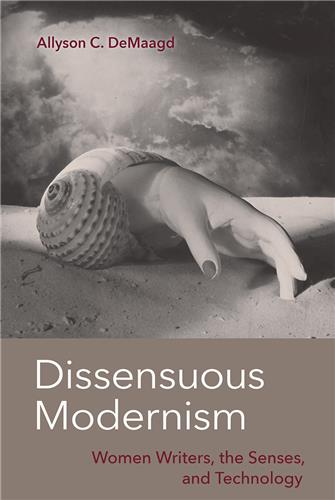
Dissensuous Modernism: Women Writers, the Senses, and Technology

BY ALLYSON C. DEMAAGD


UP of Florida, 2022

ISBN: 9780813069166

https://upf.com/book.asp?id=9780813069166


Placing women writers at the center of the sensory and technological experimentation that characterized the modernist movement, Dissensuous Modernism shows how women of the era challenged gendered narratives that limited their power and agency and waged dissent through their radical sensuous writing.  

BOOK NEWS is an online-only feature announcing new publications in modernist and contemporary literary studies. These announcements do NOT constitute an endorsement by the Journal of Modern Literature.

Allyson DeMaagd critiques an overemphasis among modernist writers and generations of researchers on the “masculine” senses of sight and sound, shifting the conversation toward the “feminine” senses of smell, taste, and touch. These senses, long considered “lower,” were explored by writers such as H.D., Mina Loy, Virginia Woolf, and Elizabeth Bowen, as DeMaagd demonstrates through detailed close readings of their lesser-studied novels. DeMaagd’s analysis shows how these women incorporated technology in their work to reunify the senses or to draw attention to the destructive disunity of the senses, highlighting the subversive potential of sensory integration.            

Dissensuous Modernism illuminates how modernist women writers breached the sensory borders society erects between men and women, heteronormativity and queerness, ability and disability, technology and nature, and human and nonhuman. It elevates diverse embodied experiences and illuminates the pivotal role of women in modernist sensory thought.  

“DeMaagd’s timely study examines the changing sensescape in modernist aesthetics and gives the long-denigrated ‘lower’ senses of smell, taste, and touch their interpretive due, not only uncovering the gendering of sensory experience but also demonstrating the extent to which sensory practices crucially involve questions of class, sexual orientation, (dis)ability, and species.”—Vicki Tromanhauser, SUNY New Paltz  

“Redressing the focus on visual senses that has dominated discussions of modernist (usually male) writers, Dissensuous Modernism argues that these modernist women writers call upon the underacknowledged senses of touch, feel, and smell in questioning gendered hierarchies of embodied and institutional power.”—Linda A. Kinnahan, editor of A History of Twentieth-Century American Women’s Poetry  


Allyson C. DeMaagd is an independent scholar and college success manager at Mid-Shore Scholars.

Monday, March 13, 2023

Book News: Women modernists' collaborations with men

 Modernist Literary Collaborations between Women and Men

BY RUSSELL MCDONALD


Cambridge UP, 2022

ISBN: 9781009070973

https://www.cambridge.org/core/books/modernist-literary-collaborations-between-women-and-men/


Major figures including W. B. Yeats, Marianne Moore, D. H. Lawrence, Ford Madox Ford, and Virginia Woolf viewed "cross-sex" collaboration as a valuable, and often subversive, strategy for bringing women and men's differing perspectives into productive dialogue while harnessing the creative potential of gendered discord. This study is the first to acknowledge collaboration between women and men as an important part of the modernist effort to "make it new." 

BOOK NEWS is an online-only feature announcing new publications in modernist and contemporary literary studies. These announcements do NOT constitute an endorsement by the Journal of Modern Literature.

Drawing on current methods from textual scholarship to read modernist texts as material, socially constructed products of multiple hands, the study argues that cross-sex collaboration involved writers working not just with each other, but also with publishers and illustrators. By documenting and tracing the contours of their desire for cross-sex collaboration, we gain a new understanding of the modernists' thinking about sex and gender relations, as well as three related topics of great interest to them: marriage, androgyny, and genius.


Russell McDonald is associate professor of English at Georgian Court University. His articles and reviews have appeared in Textual Cultures, Irish Studies Review, Twentieth-Century Literature, New Hibernia Review, and Comparative Literature Studies.

Friday, February 17, 2023

Book News: Modernist writers wrestle with Freud's legacy

Secret Sharers: The Intimate Rivalries of Modernism and Psychoanalysis

BY JENNIFER SPITZER


Fordham UP, 2023

ISBN: 9781531502102

https://www.fordhampress.com/9781531502102/secret-sharers/


Secret Sharers traces a genealogy of secret sharing between literary modernism and psychoanalysis, focusing on the productive entanglements and intense competitive rivalries that helped shape Anglo-American modernism as a field. As Jennifer Spitzer reveals, such rivalries played out in explicit criticism, inventive misreadings, and revisions of Freudian forms—from D. H. Lawrence’s re-descriptions of the unconscious to Vladimir Nabokov’s parodies of the psychoanalytic case study. While some modernists engaged directly with Freud and Freudian psychoanalysis with unmistakable rivalry and critique, others wrestled in more complex ways with Freud’s legacy. The key protagonists of this study—D. H. Lawrence, Virginia Woolf, W. H. Auden, and Vladimir Nabokov—are noteworthy for the way they engaged with, popularized, and revised the terms of Freudian psychoanalysis, while also struggling with it as an encroaching discourse. Modernists read psychoanalysis, misread psychoanalysis, and sometimes refused to read it altogether, while expressing anxiety about being read by psychoanalysis—subjecting themselves and their art to psychoanalytic interpretations.

BOOK NEWS is an online-only feature announcing new publications in modernist and contemporary literary studies. These announcements do NOT constitute an endorsement by the Journal of Modern Literature.

As analysts, such as Freud, Ernest Jones, and Alfred Kuttner, turned to literature and art to illustrate psychoanalytic theories, modernists sought to counter such reductive narratives by envisioning competing formulations of the relationship between literature and psychic life. Modernists often expressed ambivalence about the probing, symptomatic style of psychoanalytic interpretation and responded with a re-doubling of arguments for aesthetic autonomy, formal self-consciousness, and amateurism. Secret Sharers reveals how modernists transformed the hermeneutic and diagnostic priorities of psychoanalysis into novel aesthetic strategies and distinctive modes of epistemological and critical engagement. In reassessing the historical and intellectual legacies of modernism, this book suggests that modernist responses to psychoanalytic criticism anticipate more recent critical debates about the value of “symptomatic” reading and the “hermeneutics of suspicion.”


If modernism was anything, it was a literature of consciousness. For that reason, Freud and psychoanalysis have long been seen as crucial context to the literary innovations of the early twentieth century. Secret Sharers, however, troubles received notions about the role of Freud within literary modernism, offering a new narrative in which modernism was shaped by an engagement that was both anxious and constitutive. Jennifer Spitzer’s book is a timely invitation to reexamine modernism’s fundamental concerns and their bearing on the work we do as literary critics.---Timothy Wientzen, author of Automatic: Literary Modernism and the Politics of Reflex

Spitzer moves beyond standard accounts of literary modernism’s debt to Freud to show how practicing psychoanalysts and modernist writers worked in close proximity on the same terrain—narrating the minds of others, interpreting the meaning of texts, theorizing queer experience. Attuned to subtler forms of influence and reaction—and featuring an ensemble cast of secondary characters who practiced or wrote about Freudian psychoanalysis—Secret Sharers offers a revelatory account of the rise of modernist conceptions of literary autonomy.---Laura Heffernan, author of The Teaching Archive: A New History for Literary Study


Jennifer Spitzer is associate professor in the Department of Literatures in English at Ithaca College. Her work has appeared or is forthcoming in Modernism/Modernity, the Journal of Modern Literature, Studies in the Novel, Modern Language Quarterly, the New York Times, the Los Angeles Review of Books, Avidly, and other venues.


Friday, December 16, 2022

Book News: A deep dive into Virginia Woolf's education

Virginia Woolf's Apprenticeship: Becoming an Essayist

BY BETH RIGEL DAUGHERTY


Edinburgh UP, 2022

ISBN: 9781399504515

https://edinburghuniversitypress.com/book-virginia-woolf-s-apprenticeship.html


This study takes up Woolf’s challenge to probe the relationship between education and work, specifically her education and her work as an essayist. It expands her education beyond her father’s library to include not only a broader examination of her homeschooling but also her teaching at Morley College and her early book reviewing. It places Virginia Stephen’s learning in the historical and cultural contexts of education for women, the working classes and writers in the late nineteenth and early twentieth century.

BOOK NEWS is an online-only feature announcing new publications in modernist and contemporary literary studies. These announcements do NOT constitute an endorsement by the Journal of Modern Literature.

Weaving together Virginia Stephen’s homeschooling, her teaching and her writing for the newspapers, Beth Rigel Daugherty demonstrates how these three strands shape Virginia Woolf’s essay persona, her essays, and her relationship with her readers. She also shows why Virginia Stephen’s apprenticeship compels Virginia Woolf to become a pedagogical essayist. The volume publishes two holograph draft lectures by Virginia Stephen for the first time and mines rarely used archival materials. It also includes five appendices, one detailing Virginia Stephen’s library and another her apprenticeship essays.

This is the first in a two-volume study of Virginia Woolf’s essays that analyzes Virginia Stephen’s development and Virginia Woolf’s achievements as an essay writer.


Drawing on deep research into the social history of women’s lives and of education, Daugherty shows with superb attention to detail how Virginia Stephen’s early experiences of teaching and of being taught nourished the seeds that flowered as Virginia Woolf, "an essayist compelled to teach." This is impeccable and important scholarship. -– Mark Hussey, Distinguished Professor Emeritus, Pace University


This electrifying magnum opus illuminates Virginia Woolf’s formative experience of teaching working-class adult students while starting her own career as a freelance book reviewer. Beth Rigel Daugherty shows how helping and identifying with novice learners influenced Woolf’s nonfiction aesthetic. Over many subsequent years, Woolf made a striking attempt to write essays in ways that would welcome ordinary readers.

Virginia Woolf’s Apprenticeship launches a new era in the way Woolf is assessed and will stimulate scholars, teachers, and writers in the broad and burgeoning genre of creative nonfiction. Deeply researched historically and biographically, it contributes beyond Woolf studies to the fields of memoir, personal essay, journalism, and pedagogy. Warm of manner and lively of style, it has a bold and ambitious purpose: to help us see Virginia Woolf anew as a working, learning, growing person and writer. Woolf emerges as someone deeply concerned with connecting with others regardless of their class and gender, thereby attempting to transcend the limits of her family, her heritage, and her time. Showing this is the book’s larger, remarkable achievement. – Richard Gilbert, MFA, nonfiction author, teacher, and publisher


Recently retired from Otterbein University in Ohio, Beth Rigel Daugherty taught modernist English literature, Virginia Woolf and Appalachian and Native American literature along with many thematically focused writing courses for 36 years. Falling in love with Virginia Woolf and her essays while at Rice University, she has been presenting and publishing on both ever since with peer-reviewed articles in edited collections; editions of the “How Should Read a Book?” holograph draft and Woolf’s fan letters in Woolf Studies Annual; and, with Mary Beth Pringle, the Modern Language Association teaching volume on To the Lighthouse.

Tuesday, November 1, 2022

Book News: Woolf's invocation of Greek mythology

Virginia Woolf's Mythic Method

BY AMY C. SMITH


Ohio State UP, 2022

ISBN: 978-0-8142-1513-5

https://ohiostatepress.org/books/titles/9780814215135.html


In Virginia Woolf’s Mythic Method, Smith reinvigorates scholarly analysis of myth in Virginia Woolf’s fiction by examining how Woolf engaged social and political issues in her work. Through close readings of Mrs. Dalloway, To the Lighthouse, and Between the Acts, Smith argues that Woolf develops a paratactic method of alluding to Greek myth that is shaped by the style of archaic oral literature and her intersectional feminist insights. By revising such famously paradoxical figures as the Great Goddess, the Eleusinian deities, Dionysus, Odysseus, and the Sirens, Woolf illustrates the links between epistemological and metaphysical assumptions and war, empire, patriarchy, capitalism, and fascism.

BOOK NEWS is an online-only feature announcing new publications in modernist and contemporary literary studies. These announcements do NOT constitute an endorsement by the Journal of Modern Literature.

At the same time, her use of parataxis to invoke ancient myth unsettles authorial control and empowers readers to participate in making meaning out of her juxtaposed fragments. In contrast to T. S. Eliot’s more prominent mythic method, which seeks to control the anarchy of modern life, Woolf’s paratactic method envisions more livable forms of sociality by destabilizing meaning in her novels, an agenda that aligns better with our contemporary understandings of modernism.

“Virginia Woolf’s Mythic Method is a fresh, nuanced, and innovative examination of Mrs. Dalloway, To the Lighthouse, and Between the Acts viewed through the dual lenses of myth and modernism. Smith’s richly layered analysis and excellent scholarly sources position this book to shape future interpretations of Woolf’s work.”     —Vara Neverow, editor of Virginia Woolf Miscellany


Amy C. Smith is associate professor of English at Lamar University.

Tuesday, September 20, 2022

Book News: Woolf's engagement with science

Virginia Woolf, Science, Radio, and Identity 

BY CATRIONA LIVINGSTONE


Cambridge UP, 2022

ISBN: 9781316514078

https://www.cambridge.org/us/academic/subjects/literature/english-literature-1900-1945/virginia-woolf-science-radio-and-identity?format=HB

This book offers an extensive analysis of Woolf's engagement with science. It demonstrates that science is integral to the construction of identity in Woolf's novels of the 1930s and 1940s, and identifies a little-explored source for Woolf's scientific knowledge: BBC scientific radio broadcasts. By analyzing this unstudied primary material, it traces the application of scientific concepts to questions of identity and highlights a single concept that is shared across multiple disciplines in the modernist period: the idea that modern science undermined individualized conceptions of the self. It broadens our understanding of the relationship between modernism and radio, modernism and science, and demonstrates the importance of science to Woolf's later novels.

BOOK NEWS is an online-only feature announcing new publications in modernist and contemporary literary studies. These announcements do NOT constitute an endorsement by the Journal of Modern Literature.

  • Explores Woolf's engagement with four areas of modernist science: quantum physics, neurology, radio, and evolutionary science
  • Includes detailed accounts of early BBC science broadcasts
  • Demonstrates that the popular science of the modernist period participates in the construction of multiple, expansive models of identity that is characteristic of modernist literature

Catriona Livingstone's work has appeared in Women: A Cultural Review, Woolf Studies Annual, and the Journal of Literature and Science. She co-organized the 2017 British Society for Literature and Science Winter Symposium, and was awarded an Honorable Mention in the Journal of Literature and Science/BSLS Essay Prize in 2017.

Monday, July 25, 2022

JML 45.3 (Spring 2022) is LIVE!

JML 45.3 (Spring 2022) on the theme "New Materialisms" is now live on Project Muse at https://muse.jhu.edu/issue/48204


Content includes:


Jennifer Yusin

Editorial Changes

FREE!


Marit Grøtta

Showing Seeing: The Study of Faces and Portrait Photographs in Virginia Woolf’s Early Novels 


Rachel Murray

Things that Cling: Marine Attachments in Eliot 

FREE!


Emma Felin

Faith and Fabrication in To the Lighthouse: Virginia Woolf’s Table-Cloth(s)


Olga Zolotareva

The Image Responds: Photographic Aura in Aleksandr Ivanov’s “Stereoscope” 


Matt Prout

Art or Shit: Value, Sincerity, and the Avant-garde in David Foster Wallace 


Zackary Vernon

Faulkner’s Charismatic Megaflora: Critical Plant Studies and the US South


Quan Zhou and Qiping Liu

Agentic Things and Traumatized People in Toni Morrison's The Bluest Eye


Aaron McCullough

Sheaths, Molds, and Shards: The Formation of an Anthropological Aesthetics in Willa Cather’s The Song of the Lark


Alyson Brickey

“Fragments of cloth, bits of cotton, lumps of earth”: Object-Oriented Lists in Let Us Now Praise Famous Men 


James Draney

W.G. Sebald’s Paper Universe: Austerlitz and the Poetics of Media Obsolescence 


Reviews

Zachary Kinsella

Becoming Bewildered


Tim Clarke

Modernist Women’s Writing and the Gift of Literature 


Karina Jakubowicz

From Waste Lands to Farmhands: T.S. Eliot and the Organic Husbandry Movement 


Jeffrey Careyva

The Evanescence of Lyric: A Review of John Wilkinson’s Lyric in Its Times: Temporalities in Verse, Breath, and Stone