Welcome to the Journal of Modern Literature news and information site.


Check here for updates about our latest issues, calls for papers, submission guidelines and tips, as well special online-only content. Our issues themselves are available at Project Muse and are archived on JSTOR . Check out the "Read for Free" page to enjoy some featured content.


More than four decades after its founding, the Journal of Modern Literature remains a leading scholarly journal in the field of modern and contemporary literature and is widely recognized as such. It emphasizes scholarly studies of literature in all languages, as well as related arts and cultural artifacts, from 1900 to the present. International in its scope, its contributors include scholars from Africa, Asia, Europe, North America, Oceana, and South America.

Showing posts with label interdisciplinary studies. Show all posts

Tuesday, January 31, 2023

Book News: Transdisciplinary study of literary madness

Madness And Literature: What Fiction Can Do for the Understanding of Mental Illness

EDITED BY LASSE R. GAMMELGAARD


U of Exeter P, 2022

ISBN: 9781905816378

https://www.exeterpress.co.uk/products/madness-and-literature


Mental illness has been a favorite topic for authors throughout the history of literature, while psychologists and psychiatrists such as Sigmund Freud and Karl Jaspers have in turn been interested in and influenced by literature. Pioneers within philosophy, psychiatry and literature share the endeavor to explore and explain the human mind and behavior, including what a society deems as being outside perceived normality.

BOOK NEWS is an online-only feature announcing new publications in modernist and contemporary literary studies. These announcements do NOT constitute an endorsement by the Journal of Modern Literature.

Using a theoretical approach that is eclectic and transdisciplinary, this volume engages with literature’s multifarious ways of probing minds and bodies in a state of mental ill health. The cases and the theory are in dialogue with a clinical approach, addressing issues and diagnoses such as trauma, psychosis, bipolar disorder, eating disorders, self-harm, hoarding disorder, PTSD and Digital Sexual Assault.

The chapters in Part I address literary representations of madness with a historical awareness, outlining the socio-political potentials of madness literature. Part II investigates how representations of mental illness in literature can offer unique insights into the subjective experience of alternative states of mind. Part III reflects on how literary cases can be applied to help inform mental health education, how they can be used therapeutically and how they are giving credence to new diagnoses. Throughout the book, the contributors consider how the language and discourses of literature—both stylistically and theoretically—can teach us something new about what it means to be mentally unwell.


There’s news here that moves us to reconsider not only what literature can teach us, but how it can teach us, and even be of service to people living with mental illness and those who treat and care for them. Here’s a lively and far-reaching contribution to the field of medical humanities. -- Maura Spiegel, division of narrative medicine, Columbia University

A wonderful array of critical and reflective accounts about literature representing mental illness in keeping with a health humanities approach that values interdisciplinary, inclusive and potentially applicable knowledge. -- Paul Crawford, professor of health humanities, University of Nottingham


Lasse R. Gammelgaard is associate professor at the Department of Communication and Culture at Aarhus University, Denmark, where he is co-director of the research group Health, Media and Narrative. He is author of the high school textbook Galskab i litteraturen [Madness in Literature]. His articles appear in Narrative, Style, Samuel Beckett Today / Aujourd'hui and Journal of Research in Sickness and Society among others.

Friday, August 5, 2022

Book News: Future studies' relevance to literary studies

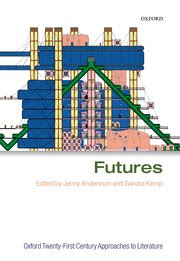
Futures

EDITED BY SANDRA KEMP AND JENNY ANDERSSON


Oxford UP, 2021

ISBN: 9780198806820

https://global.oup.com/academic/product/futures-9780198806820?cc=us&lang=en&#


Futures examines the relevance of futures studies to literary studies. It demonstrates how the growing interest in futures thinking is opening up multidisciplinary conversations and initiatives, examining historical and contemporary forms of futures knowledge, the methodologies and technologies of futures expertise, and the role played by different institutions on legitimizing, deploying, and controling anticipatory practices.

BOOK NEWS is an online-only feature announcing new publications in modernist and contemporary literary studies. These announcements do NOT constitute an endorsement by the Journal of Modern Literature.

Bringing together emerging perspectives on the future from diverse disciplinary perspectives including critical theory, design, anthropology, sociology, politics, and history, this book places the provocation of power at the heart of the book through an investigation of futures as both objects of science and objects of the human imagination, creativity, and will. A multidisciplinary team of contributors challenge and debate the varied ways in which futures are conjured and constructed, exploring issues as diverse as the utopian imagination, history and philosophy, literary and political manifestos, artefacts and design fictions, and forms of technological and financial forecasting, big data, climate modelling, and scenarios.

The book positions the future as a question of power, of representations and counter-representations, and forms of struggle over future imaginaries. Forms of futures-making depend on complex processes of envisioning and embodiment. Each chapter investigates the critical vocabularies, genres, and representational methods -- narrative, quantitative, visual, and material -- of futures-making as deeply contested fields in cultural and social life.


Sandra Kemp is director, The Ruskin—Library, Museum and Research Centre at Lancaster University. She is professor in the history department at Lancaster University and visiting professor at Imperial College London. As an academic and curator, her futures-related work spans the exhibition and monograph Future Face: Image, Innovation, Identity (2004-6) at the London Science Museum and subsequent South Asian exhibition tour; The Future Is Our Business: The Visual History of Future Expertise project at the V&A (2013); and Ruskin: Museum of the Near Future at The Ruskin, Lancaster University in 2019. She is Principal Investigator for the AHRC/Labex-funded Universal Histories and Universal Museums project on the role of the museums in Europe in building knowledge about the future.

Jenny Andersson is professor of the History of Ideas and Science at Upsala University, Sweden.