Welcome to the Journal of Modern Literature news and information site.


Check here for updates about our latest issues, calls for papers, submission guidelines and tips, as well special online-only content. Our issues themselves are available at Project Muse and are archived on JSTOR . Check out the "Read for Free" page to enjoy some featured content.


More than four decades after its founding, the Journal of Modern Literature remains a leading scholarly journal in the field of modern and contemporary literature and is widely recognized as such. It emphasizes scholarly studies of literature in all languages, as well as related arts and cultural artifacts, from 1900 to the present. International in its scope, its contributors include scholars from Africa, Asia, Europe, North America, Oceana, and South America.

Showing posts with label book review. Show all posts

Thursday, April 24, 2025

BOOK REVIEW: Is the Welfare State a Hegelian Legacy?


By Philip Tsang, Colorado State University

Benjamin Kohlmann. British Literature and the Life of Institutions: Speculative States. Oxford UP, 2022. 268 pp. $100.00 hardcover; $87.99 e-book.


Benjamin Kohlmann’s new book British Literature and the Life of Institutions enriches the bourgeoning scholarship on the welfare state in two distinct ways. First, it reassesses British literature from 1880 to 1910. For Kohlmann, this period is not one of crisis or decadence, a mere prelude to the high modernism of the 20s and 30s. Rather, the literature of this period evinces a sustained reformist aesthetic that imagines the state as a vital force in social life. Questioning the critical fixation on revolutionary rupture in modernist studies, Kohlmann attends instead to the “slow politics of reform” (2), a shared effort among late Victorian and Edwardian writers to rework and improve state institutions. As such, “the reformist literary mode is Hegelian rather than Marxist insofar as it imagines the gradual transformation of existing social conditions” (5). This is no casual observation, for Kohlmann proceeds to investigate the British reception of Hegel around 1900. His account of how British writers adapted Hegel’s speculative philosophy to reformist ends is his book’s second major contribution. His goal is not simply to trace Hegel’s influence on British literature; rather, he shows how literary texts take Hegel’s philosophy one step further by giving “abstract concepts a degree of experiential concreteness unattainable to philosophical thought alone” (5). For Kohlmann, speculation is no mere conjecture, but an effort of concretization.

British Hegelianism provides the theoretical groundwork for Kohlmann’s book. While previous studies of this loosely formed movement, such as those by Robert Stern and Peter Robbins, have explored British writers’ engagement with Hegel’s metaphysics, what distinguishes Kohlmann’s account is his focus on late Hegel. For Victorian readers, Hegel’s most influential work was neither the Phenomenology of Spirit nor the Science of Logic, but the Philosophy of Right, a book concerned with the role of state institutions. Kohlmann sees the selective reception of Hegel among British intellectuals as an advantage rather than a drawback because it allowed them to articulate a concrete vision of the state without the burden of metaphysics. The Philosophy of Right led those intellectuals, most notably Thomas Hill Green, David George Ritchie, Bernard Bosanquet, and Ernest Belfort Bax, to regard state institutions not as externally imposed structures but as shared forms of life that facilitate the thriving of individuals. Green, for instance, disputes Locke’s theory of individual freedom and instead argues for active citizenship and the common good to counter capitalist fragmentation. Similarly, Ritchie calls for the redistribution of property rights and for more state regulations of the economy. Kohlmann thus offers an important corrective to scholarly accounts of Hegelian philosophy as teleological and totalitarian. Those accounts are reductive because they have ignored how “Hegelianism attracted a wide range of ideological positions to itself, and that it managed to transform these positions in its turn” (36). This variety also characterizes Kohlmann’s literary case studies. In the remainder of his book, he explores how novelists and poets from a broad ideological continuum enfold Hegelian speculation into their responses to such diverse issues as the settlement movement, land ownership, taxation, and national insurance.

Given his investment in speculative thinking, it comes as no surprise that one of the key writers in the book is H. G. Wells. Kohlmann focuses, however, less on Wells’s early works of science fiction than on his lesser-known Edwardian novels, in which the author scales back his futuristic imagination to explore more local, gradualist possibilities of change. In particular, Kohlmann highlights Wells’s engagement with the tax reforms in the 1900s. His 1905 novel A Modern Utopia envisions a distant planet that shares many similarities with Edwardian Britain. The continuity between the two worlds allows for a critique and reimagination of existing governmental systems. Through this Hegelian style of “non-revolutionary reformist thinking,” Wells defends private property but also sees it as fluid and kinetic, amenable to public use through progressive taxation (168). The novel thus redefines utopia as a reformist rather than revolutionary genre: “Wells’s future-directed legislative utopianism entails the aspirational repurposing of the resources of the present, rather than a projection of radical revolutionary alterity” (165). Contrary to his earlier works, A Modern Utopia represents Wells’s “aspirational realism,” which entails a reworking rather than rejection of the status quo (176).

A more surprising choice for Kohlmann’s study is E. M. Forster, who seems to favor the spontaneity of interpersonal connection over any kind of state-level supervision. His 1909 tale “The Machine Stops” attests to his deep skepticism about centralized governance. Yet his 1910 novel Howards End, written in the midst of public debates that would eventually lead to the passing of the National Insurance Act in 1911, is more receptive to the benefits of institutional reform. For Kohlmann, the fact that Leonard Bast initially works as an insurance clerk and later becomes unemployed is not accidental; rather, it “raises broader questions about the social allocation of economic vulnerability and about the promise of publicly funded mechanisms of institutionalized care” (200). Howards End presents a world full of risk and uncertainty, epitomized by the novel’s pivotal event: Mrs. Wilcox’s sudden death. That misfortune teaches Margaret Schlegel that one cannot prepare for every danger and should instead embrace risk in order to live life to the full. Kohlmann, however, detects an irony in Margaret’s warning about the “tragedy of preparedness”—namely, that to live life unplanned and unprepared requires a safety net that provides material assistance during hard times. The Wilcoxes can lead an exciting and reckless life only because they have private insurance. Contrary to Margaret’s suggestion, the real tragedy here is the “tragedy of unpreparedness,” which “shows that life cannot be fully enjoyed unless it is cushioned against the worst kinds of socio-economic risk” (216). This reading exemplifies Kohlmann’s central argument: personal freedom and well-being are not threatened but rather protected and enriched by institutional mediation. Or, to drive home the Hegelian point, individual potential can be actualized only through the state. Kohlmann goes so far as to call Howards End a “welfare state novel” (191), reading its famous epigraph “Only connect…” not as some abstract ideal of interpersonal or interclass connection, but as a concrete reformist proposal for institutionalized care and economic redistribution. 

Throughout Kohlmann’s book, speculation is an ethos, a perspective, and a style that describes not only the literary works in question but also Kohlmann’s reading method. This style, as he puts it succinctly in relation to Ernest Belfort Bax, discloses “how substantive contradictions unfold from within—how they are ‘opened up’ for us by—a given situation” (55). Kohlmann’s speculative style allows for a wide interpretative latitude. In his reading of George Gissing’s 1887 novel Thyrza, he concludes that the protagonist’s uncompromising idealism prevents him from recognizing the possibility of institutional reform. That failure, however, becomes in turn “the very medium through which reformist hopes must be realized” (83). Kohlmann’s speculative reading recasts Gissing’s uneven novel as a polyphonic work in which a wide range of political positions are tested and negated. In a distinctly Hegelian fashion, he patiently shows how contradictions and instabilities within a text can lead to positive and generative outcomes. In the end, it does not matter what positions the authors take regarding taxation or insurance. Whether by supporting, critiquing, or decrying efforts at institutional reform, those writers engage in an act of speculation that is at once diagnostic, aspirational, and reparative. Kohlmann shows us that literary reading, too, can be a speculative act in itself.

I want to close with two questions. One is simply why British literature’s reformist imagination was so short-lived. According to Kohlmann, Edward Carpenter’s preoccupation with land reform in the 1880s gave way to an immersion in Hindu philosophy in the next decade; Wells’s ambitious agenda for redistributive taxation in A Modern Utopia gave way to a “claustrophobic vision of parliamentary infighting” in his 1911 novel The New Machiavelli (187); Forster followed Howards End with Arctic Summer, his “most sustained attempt to enter imaginatively into the reformist literary mode,” but he eventually abandoned the project (217). Like Wells’s A Modern Utopia, the reformist aesthetic’s all-too-short trajectory seems to be a narrative of “undeveloped possibilities” cut short by the advent of modernism. In Kohlmann’s account, interwar modernism signals a decisive break with the reformist aesthetic (69). Yet, in light of his speculative method, one wonders whether high modernism, despite its longstanding association with rupture and novelty, might share more continuity with the reformist imagination than Kohlmann presents here. Might war, revolution, and imperial decline have invigorated new styles of speculative institutionalism from Bloomsbury to Bengal?

My second question concerns the role of literature in state institutions. If, as Kohlmann powerfully shows, literature was the medium through which to cultivate the ethos of sharing and caring, might one make a stronger case for literature as a fundamental aspect of the state on par with taxation and insurance? One might recall that Leonard Bast is not just an insurance clerk but also an avid reader, though his primary goal is self-improvement. Yet if the Wilcoxes’ private insurance can buttress Howards End’s advocacy for national insurance, perhaps it is not too far-fetched to regard the ostensibly private act of reading as serving an institutional function toward the common good. What modes, practices, and pedagogies of reading are best suited to that end? This might be Kohlmann’s biggest provocation yet.


Philip Tsang teaches modernist and postcolonial literature at Colorado State University. He is the author of The Obsolete Empire: Untimely Belonging in Twentieth-Century British Literature, which traces an aesthetic of frustrated attachment in the context of imperial decline.


Monday, May 1, 2023

The Devil Is in the Details: A Review

 By Yael Levin, The Hebrew University of Jerusalem


Johan Adam Warodell. Conrad’s Decentered Fiction. Cambridge UP, 2022. 290 pp. $99.99 hardback or ebook.


Johan Warodell’s Conrad’s Decentered Fiction is like no other book of Conrad criticism. It is, rather, a cabinet of curiosities: a collection of details that Conradians have consistently overlooked. The reason for this is double. First, such details resist sweeping generalizations and theoretical agendas; they are always in excess of meaning. Second, peripheral and secondary, they tend to congregate in the critic’s blind spot. The two points are contradictory: either we see them and cannot answer for their multiplicity, or we do not see them at all, as they are not consequential enough to draw our attention. Like other contradictions offered in this study, the two possibilities live together happily without need for synthesis. Regardless of its underlying cause, Warodell views the critic’s failure to account for these details as evidence of a significant gap between the critic’s output and the reading experience. This is an interesting point of departure for the book, as it harbors the promise of a different Conradian experience, one that will be more attuned to the stuff of the fiction than the ideological agendas an interpreter might foist upon it. An interpretation will always have to rely on given categories, forms of understanding that are outside the text and must be artificially imposed on it in the course of the hermeneutic process. Warodell will have none of that. As he notes: “by shifting our interest to the details, and decentering our gaze, we can pay more attention to the content of books rather than, say, entertain an idea about an overarching and superseding argument” (8).

A helpful conceptual hinge for the project is offered in the term “eclectic” —a word whose history rests precisely on the difference between an ideologically-motivated selection and a random collection of objects. The materials Warodell brings together are just that: catalogues of, inter alia, Conradian animals, hats and unpublished marginalia. The monograph sets out to prioritize detail above the thematic, categorical, topical and conceptual. This is an interesting experiment, even when it fails to do what it promises and reverts back to the very critical practice it warns against. In suggesting that “Conrad’s authorship is unified by its eclecticism” (11), Warodell shows he is not immune to the critic’s urge to center, to unify, to interpret. We are asked to consider doing things differently, but the book occasionally yields the suspicion that this is very hard to do. Though it shows the urge to unify or interpret might be difficult to overcome, it does offer methodological alternatives. Definitive arguments or interpretations are often dropped for speculation and an open-ended critical probing. What is lost in the exchange are the conclusions we often look for in a book of criticism. Perhaps this is precisely the point. Whether or not we are convinced by these new methods or accept this resistance to clear-cut claims, the invitation to do things differently is valuable. The experiment raises important questions about our contemporary critical methods and their limitations.  

The experiment raises important questions about our contemporary critical methods and their limitations.

The first part of the book is devoted to Conrad’s marginalia: doodles, maps, and drawings that accompany the writing process. The chapter on maps offers a panoply of cartographic possibilities: real, imaginative; stage maps and stage directions. All are read as attempts to represent the story world outside language. Warodell treats these interchangeably; he is not interested in their ontological coordinates but in their relationship to the text. The investigation is speculative, as there is an attempt to describe a connection between the author’s creative process (as represented by the maps) and the artistic output (the work itself). Such a connection might be mimetic, inspirational, or operational. And these questions lead to others — is the connection between the two too intimate to be accessed by an audience of readers or critical thinkers? The chapter offers a survey of ways of thinking the maps with the work. Many connections are drawn, none are presented as definitive.

The following chapter offers a similar probing of the drawings attached to the writing of the unfinished novel The Sisters. The reading here is more programmatic. The attempt to date extant drawings so as to ascribe them to moments in the writing process brings genetic criticism in aid of a dismantling of critical dismissals of the work. Warodell wonders whether we can use Conrad’s drawings as a method to unravel Conrad’s interest in or engagement with the theme of the aspiring artist. In doing so he undermines previous devaluations of the work, critiques that hinge on an assumption of Conrad’s ignorance of the artform. Richard Curle’s statement that Conrad had no interest in visual art is one such example. The chapter works against this early critical response and its culmination in Zdzislaw Najder’s claim that The Sisters is a lesser work because it is not rooted in personal experience. By calling on biographical detail and the sketches themselves, the chapter tries to establish Conrad’s familiarity with, and interest in, the visual arts. It is surprising, then, that the argument concludes with the comment that “Regarding The Sisters and its autobiographical ingredients, the question about whether Conrad liked, practiced and understood painting should, perhaps, not be overemphasized” (59). 

An even more surprising conclusion awaits the reader in the second part of the book where Warodell researches the flying sticks in Heart of Darkness. “Published Texts: Working Method and Philosophy,” may well be the most rewarding section of the study. It opens with a reading of Bertrand Russel’s logical atomism as a philosophic “justification” for Conrad’s work. Such framing of the chapter might be grating to literary critics who feel this is an unnecessary resurrection of the ancient quarrel between philosophy and literature. A more helpful critical reasoning behind the juxtaposition is soon provided. The challenge is not disciplinary but theoretical; Warodell’s turn to Russell is an invitation to look at Conrad’s art not through the prism of artistic impressionism but through the findings of analytic philosophy. This is not an obvious theoretical turn in a work devoted to Conrad’s details. Impressionism is an artistic style that is attuned to the very stuff of experience. In an early association of Conrad’s work with impressionism, Harold Davis discusses the revisions to The Secret Agent and their investment in detail. The “enlargement and clarification of the mood and background” is achieved “by rendering the details exactly instead of reporting them, the basic tenet of literary impressionism as Ford, James, and Crane defined it” (245). Warodell does not dispute these readings and their culmination in John G. Peters’s Conrad and Impressionism (2001). Rather, he presents Russell’s logical atomism as a method to complement the discussion: “by discussing the analytic philosophy of Bertrand Russell, the picture of Conrad’s writing and his impressionism is more explicitly tied to sensory detail than in Conrad and Impressionism, where expansive discussion of literary impressionism included ‘the gamut of objects of consciousness: physical objects, human subjects, events, ideas, space, and time’” (72). 

This section of the book is particularly rewarding where it challenges Ian Watt’s long-accepted principle of delayed decoding. For Warodell, Watt’s concept is too teleologically oriented to be squared with a novella that values multiple meanings and openness. Instead of Watt’s suggestion of the either/or of the process of perception (we perceive the stimuli correctly as arrows or misperceive them as sticks) Warodell suggests a “tripartite transition” that can fit into “an endless chain of nonhierarchical observations” (80). This is an interesting alternative to a term all Conrad scholars have come to see as foundational for the author’s art. It provides a welcome rereading of a familiar Conradian strategy. If I do not wholeheartedly accept this tripartite transition, it is because it does not quite work with the text. Warodell is right to draw out the ambiguity and multivalence of Heart of Darkness. However, it is precisely in those moments of delayed decoding that ambiguity is dropped. There is a right and a wrong way of understanding the originally confusing sensory data — whether these are sticks flying through the air or carved ivory balls on sticks. Marlow’s realization that the company is under arrow attack, his epiphany on the nature of the ornamentations around Kurtz’s hut — these moments of comprehension are necessary and unambiguous. They are moments that the novella offers as anchors of orientation in a wealth of confusing and figurative detail that is otherwise opaque. It is because of this, one would imagine, that the critics Warodell mentions (for example, Andrew Michael Roberts) support Watt’s reading. One critic who is not mentioned here but offers an important gloss on the limitation of Watt’s term is Hugh Epstein. In Hardy, Conrad and the Senses (2020), Epstein suggests that delayed decoding “implies a destination for experience in the mind which, once reached, does away with the original phenomena of the experience by intellectual dematerialization into mental terms” (34). This is perhaps a more immediate way of pinpointing how the principle of decoding does away with the truth of sensory experience. 

Much like the presentation of these sticks and ornaments in the novella, Warodell’s chapter ends with its own surprise revelation. Conrad’s arrows are not quite like the arrows of Victorian literature; they do not make the sounds “traditionally” expected. His conclusion is that “on the basis of decoding that covers textual analysis and historical context (to illustrate how arrows were perceived), it is difficult to see how the sticks could be arrows” (92). Marlow, it transpires, may have well gotten it wrong. 

The following chapter rereads the major novels as books of distraction. Not distracted narrative, but narratives about distraction. Moments of or indications of distraction are brought out in readings of The Secret Agent and Under Western Eyes. Such rereadings are particularly welcome, as they offer a defamiliarizing return to well-known novels and the well-established critical tradition that accompanies them.

“Patterns and Preoccupations: Marginal Voices and Characters” closes the study with a collection of odds and ends — the voices of social outcasts in The Nigger of the ‘Narcissus,’ hats in Nostromo, “The Secret Sharer” and The Secret Agent, and a catalogue of Conradian animals as they appear throughout the fiction. These irreconcilable details are entirely Warodell’s own; they have become a trademark of his critical work. And not without merit. This part of the book perhaps speaks for the project in its entirety: it is a book of details and facts and the lists that collect them. It is a book of speculation on those details and their relation to the author and his creative life. Here too we see that, even as he warns against overinterpretation and biographical interpretation, Warodell occasionally falls into these very traps. The call to avoid abstractions and deeper meanings is not easily realized. On hats, for example, Warodell states: “Conrad leaves us with the idea that while we may think that we wear hats, hats are clothed in meaning and may even wear us; there is no clear boundary between object and person; an everyday material object can be a key to understanding a complex individual and vice versa” (16). 

In Conrad’s Decentered Fiction Warodell brings the leftovers, trivia, objects, animals, and marginalia into a meaningful if neglected center of meaning and coherence. This is not an obvious argument to make in a book devoted to decentering — but the urge to unify here is still present and real. Warodell’s comment about Conrad’s doodles in The Shadow Line may well be true of much of the critical work offered throughout the study: “what exists at the margin may be highly telling about the central message” (24). The dissonance arising from the pairing of the title and this ultimate message notwithstanding, there is value in bringing the disparate parts of the Conradverse together. The book draws our attention to the imaginative and creative work invested in the novels beyond the words on the page, those details that escape our notice and fail to attract our interest. The compelling takeaway is that writing is more than the sum of the words we read, and often more than the sum of the words that are finally published or are ever encountered.

Warodell suggests we rethink Conrad through his eclecticism, that we introduce into Conrad scholarship terms that could be coined only by reading his fiction differently; delayed miscoding, unreality effect, unprofessional narrator, distracted reading, and in medias distractionis — these are some of the newly minted terms one will find in the course of the reading. The book issues from the understanding that it is only by reading the details that we do justice to Conrad’s ideology and poetics. As Warodell concludes, “Conrad was fiercely and philosophically opposed to overreliance on generalizations and theoretical abstractions, and this outlook affected his writing” (185). 


Works Cited 

Davis, Harold E. “Conrad’s Revisions of The Secret Agent: A Study in Literary Impressionism.” Modern Language Quarterly, vol. 19, 1958, pp. 244–54. 

Epstein, Hugh. Hardy, Conrad and the Senses. Edinburgh UP, 2020.

---

Yael Levin is an associate professor of English at the Hebrew University of Jerusalem, president of the Joseph Conrad Society of America and associate provost of the Rothberg International School. She is currently working on “The Evolution of Attention in Modern and Contemporary Culture” at the Mandel Scholion Research Center. Her monographs include Joseph Conrad: Tracing the Aesthetic Principle in Conrad's Novels (Palgrave Macmillan, 2008) and Joseph Conrad: Slow Modernism (Oxford UP, 2020). Her work on modernism, postmodernism, narratology, the subject, and disability has appeared in journals and volumes including: The Conradian, Conradiana, Partial Answers, Twentieth-Century Literature, Journal of Modern Literature, and Journal of Beckett Studies.


Friday, April 7, 2023

Book Review: Humor as Anti-Didactic

By Rachel Trousdale, Framingham State University

Carrie Conners. Laugh Lines: Humor, Genre, and Political Critique in Late Twentieth-Century American Poetics. UP of Mississippi, 2022. 162 pp. $99.00 hardcover; $25.00 paper.


In Laugh Lines: Humor, Genre, and Political Critique in Late Twentieth-Century American Poetry, Carrie Conners examines the ways that poets writing between about 1960 and 2001 use humor—particularly humor based in deviations from the expectations of genre—to make non-didactic political critiques of real-world practices and power structures. She focuses her discussion primarily on four poets—Marilyn Hacker, Harryette Mullen, Ed Dorn, and Russell Edson—although she places each of these poets briefly in dialogue with another—R. S. Gwynn, Terrance Hayes, Derek Walcott, and Anne Carson, respectively. 

Laugh Lines opens with a brief introduction in which Conners sets up her primary assertion that “humor is integral to the character of contemporary American poetry” (3) and explains her temporal focus: she begins in the sixties for the era’s distinctive countercultural currents, and ends in 2001 because of the “marked shift in the political climate” that followed 9/11 (6). Conners asks why critics who are interested in the playful and comic tendencies of postmodern fiction have largely ignored humor in the era’s poetry. One answer, she suggests, may be the primacy of a prescriptive understanding of lyric poetry that typecasts it as by definition a humorless examination of the speaker’s subjectivity. Conners selects poets working in a variety of genres—formal lyric, prose poetry, epic—to cut against this definition, while arguing that “poetic genres recall the societal constructs that the poets ridicule” (9). 

Conners opens her examination of the intersection of poetic form and political protest with Marilyn Hacker. The chapter concentrates on what Conners describes as Hacker’s hedonism, by which she means Hacker’s valorization of pleasure—particularly the multifaceted physical and intellectual pleasure of an affair between an older and a younger woman in Hacker’s sonnet sequence Love, Death, and the Changing of the Seasons. The poet’s choice of received form (in this case, the sonnet) is also “a hedonistic act and consequently a political performance” (34). The political agenda, however, is saved from being “preachy or priggish, Conners asserts,” by Hacker’s “humorous delivery” (42). It might have been interesting for Conners to have elaborated this connection between hedonism and humor, and the ways in which humor is part of the pleasure the poems seek, create, and celebrate, but Conners concentrates primarily on the ways that Hacker “offers a critique of those who label her life as bad or immoral” by “representing a pleasurable, and therefore good, life of a lesbian feminist” (44).

The second chapter concentrates on Harryette Mullen’s use of “nonnarrative word play” in Sleeping with the Dictionary (45). Conners argues that Oulipo techniques allow Mullen to expose the ways that capitalism reifies the individual and language itself. Mullen’s verbal games, Conners suggests, critique the ways that “reified thought can transform words into commodities” (54), in the process codifying racism and sexism. Here, humor plays a double role: racist jokes may give jokers and audiences plausible deniability, allowing them “to gloss over the violence” of offensive terms (55), while Mullen’s challenging playfulness—structuring poems around anagrams or sound associations based racist terms, for example— “encourages the reader to interrogate the text” (61). Conners contends that “[a]lthough Mullen uses humor to show how these racist and violent terms are a part of American cultural consciousness, she also reveals that humor can be manipulated to help package and sell these terms.” (57)

Conners continues her examination of how poets use humor to critique capitalism when she turns to Ed Dorn’s Gunslinger. Conners situates Dorn’s text against President Dwight D. Eisenhower’s warning in his 1961 farewell address that the “military-industrial complex” undergirding American politics and economics may become too powerful (85). She argues that the poem mocks the capitalist-heroic figure of Howard Hughes, whom Dorn selects as a “paragon of capitalism” (79), in part because Hughes and his equivalents “mock”—in the sense of reductively imitating—the workers they exploit (81). Dorn’s mockery, by contrast, is meant to “encourage […] readers to analyze the [capitalist] system for themselves”; this will help readers avoid being “described,” or reduced to a single, branded identity (102): such description is dangerous, Conners suggests, because it encourages people (within the poem and beyond it) to conceive of themselves and of others in prescriptive, reductive terms.  

Russell Edson’s prose poems in The Very Thing That Happens, inspired by a medieval bestiary, comically subvert such reductive descriptions. Conners argues that Edson’s absurdist treatment of animals—and of humans as animal-like—implies that “we should turn our attention to our anthropocentric tendencies” and engage in a posthuman self-critique (107), with the goal of “debunk[ing] the assumption that the realms of human, animal, and inanimate are separate” (119). Of the four chapters, this one contains perhaps the most ambitious argument. It lays out not just critique (of homophobia, of capitalism) but a sustained suggestion of an alternative framework of values: “Edson’s work suggests that our world will continue to be violent unless we confront our need to elevate the status of our species and intelligence and cease to define ourselves at the expense of others” (130). 

Conners’s examination of political humor draws on a variety of theoretical sources, varying her approach productively as she treats each poet. The book consistently draws an interesting connection between formal constraint and humor, both because form raises expectations that poets can comically confound, and because, as Conners contends, form’s sometimes arbitrary limits can mimic the social and political rules these poets contest or rebel against. It would be have been helpful, though, for Conners to have had a more articulated central through-line beyond the assertion that humor helps poets avoid limited or didactic political critique. We may already know that “capitalism enables racial and gender discrimination” (79). It would be interesting to explore in more detail how genre-twisting humor casts light on that fact. If the humorous revelation of incongruity makes readers interrogate the subject matter, does it direct that interrogation? If humorous adaptations of genre help us recognize the artificiality of political constructs, what does it suggest we do about those constructs—how should we reconceive them, or are there core truths with which we could replace them? If humor is a starting point, does it suggest a direction in which we could proceed? The answers to those questions will of course vary depending on which poets we consider, but following up on the questions Conners raises may lead us to a deeper understanding not just of the political phenomena she examines but of an important difference between mockery and substantive critique.


Rachel Trousdale (www.rachelvtrousdale.com) is a professor of English at Framingham State University. She is the author of Humor, Empathy, and Community in Twentieth-Century American Poetry; Humor in Modern American Poetry; and Nabokov, Rushdie, and the Transnational Imagination.


Thursday, January 12, 2023

Close Reading the Wordless Novel: A Review

 By Daniel Worden, Rochester Institute of Technology


Grant F. Scott. Lynd Ward’s Wordless Novels, 1929-1937: Visual Narrative, Cultural Politics, Homoeroticism. Routledge, 2022. 244 pp. $170.00 hardcover; $48.95 e-book.


The woodcut artist Lynd Ward has become a fixture of modern comics history. Ward is one of the major practitioners of a “path not taken” in the multidisciplinary practice of comics art in the twentieth century. The artist created and published 6 woodcut novels between 1929 and 1937, a flurry of artistic activity that fizzled out quickly. As Grant F. Scott notes, “Ward’s novels were soon forgotten and remained out of print and largely unknown until the late 1960s,” which means that Ward’s early graphic novels (to use an anachronism that nonetheless describes Ward’s novels quite well) began to recirculate just as American comics artists such as Art Spiegelman were beginning to reevaluate the aesthetics of the medium (2). Writing in the introduction to the 2010 Library of America edition of Lynd Ward’s woodcut novels, Spiegelman recalls that “it was Ward’s audacity and confidence in wrestling with a new narrative language that won my serious admiration as a young cartoonist” (Spiegelman xiii). 

While Ward’s wordless, single-image-per-page woodcut novels do not look or read like contemporary comics, they register as an aesthetically ambitious precedent for the visual narratives now classified as comics and/or graphic novels. Influenced by European artists like Frans Masereel and Otto Nückel, whose woodcut novels he encountered while studying graphic arts in Leipzig, Lynd Ward’s woodcut novels have long been appreciated, though mainly as anomalies that are not quite literature, not quite fine art, not quite illustration, but some hybrid form evolving out of all three. In Scott’s summation, Ward “stands before the tradition of the graphic novel as a public statue that everyone admires but no one looks at very carefully” (2). 

Scott’s Lynd Ward’s Wordless Novels, 1929-1937 is the first book-length study devoted to the artist and his visual narratives. In it, Scott develops careful and contextual close readings of Ward’s woodcut narratives, most of which are collected in the Library of America edition of Ward’s novels. Indeed, Scott’s book could even serve as a critical companion to the Library of America’s Lynd Ward: Six Novels in Woodcut (2010); this could be an exceptionally generative pairing for a graduate seminar on comics history or modernism. Scott’s book is organized into an introductory chapter about Ward’s biography and critical reception, chapters about each of Ward’s 6 complete woodcut novels as well as the unfinished Hymn for the Night, and an epilogue about another unfinished work, published in a small edition in 2001 as Dance of the Hours; or, Lynd Ward’s Last Unfinished Wordless Novel. 

Each chapter’s title signals the themes identified in each work, moving from the first biographical chapter into formal considerations, historical commentary, racial and sexual imagery, allegorical interpretation, and symbolic structures. Scott’s prose is scholarly and grounded in Ward’s texts, so much so that I was compelled to re-read each of Ward’s woodcut novels after reading its respective chapter in Scott’s book. His close attention to visual detail made Ward’s works so much richer and full of meanings than I had ever stopped to consider before. Scott’s study is valuable not just for its clear analysis and contextualization of Ward’s woodcut novels, but also because it is a reminder of what close attention to a text can accomplish. It is a comfort to read Ward’s woodcut novels slowly, which Scott’s book encouraged me to do. 

The book’s introduction provides a concise yet nuanced account of Lynd Ward’s life, as well as the major aesthetic and historical contexts that informed his work. Scott draws from Ward’s own published writings for this material—especially the collection Storyteller Without Words: The Wood Engravings of Lynd Ward (1974)—as well as archival materials from a range of libraries and art museums. Drawing on this wealth of material, Scott accounts for Ward’s aesthetic and political ideas, as well as how those ideas inform race, gender, and sexuality in Ward’s novels. Ward’s writings about woodcutting emphasize how important the tactile act of cutting into the wood is to his artwork, and with that interest in physicality and feeling, he developed a political sense of what woodcut novels could achieve as “a new kind of proletarian fiction, a handmade book for the masses” (9). 

Ward’s first book-length work, Gods’ Man (1929) tells the story of an artist’s Faustian bargain with modernity, and Scott’s analysis situates this narrative within rich artistic contexts. Linking the text’s narrative and visual style to silent film and Romantic portraiture, respectively, Scott explicates “the kinetic ambition of Gods’ Man, its desire to transcend the medial slowness and perceived anachronism of the woodcut form and represent the dynamism of the modern” (42). Scott illuminates the wordless images in Ward’s novel, making it clear how a page that depicts the novel’s artist-hero journeying to the city in Figure 1 “represents a turning point in his life, the moment of transition between the slow time of the portrait and the rapid time of the cinema, between a Romantic and a Modern form of consciousness” (44). 

Figure 1. Lynd Ward, Gods’ Man, Chapter 1, page 6.
Courtesy of the Library of America.


While Gods’ Man seems to be directly inspired by silent film and the European aesthetics that Ward encountered as an art student, his next work Madman’s Drum (1930) “aspires to the verbal density of a novel by Conrad or Faulkner” (62). In the book’s second chapter, focused on Madman’s Drum, Scott’s reading of the colonialist and racial imagery in this work acknowledges how Ward’s own political consciousness shifts alongside his aesthetic ambitions. And in Chapter 3, Scott develops these themes further by reading Wild Pilgrimage (1932) as an extension of Ward’s key themes into the context of the Great Depression and the labor struggle. In Wild Pilgrimage, lynching and exploitation under capitalism are linked, in Scott’s analysis, though the work is ultimately concerned with “a crisis of masculinity brought on by the brutish and robotic conditions of factory work” (117). 

In Chapter 4, Scott turns to Ward’s shortest woodcut novel, Prelude to a Million Years (1933), a loosely structured set of images that the critic reads in relation to William Blake’s illustrated poems. Scott also considers Ward’s illustrations for a 1934 edition of Mary Shelley’s Frankenstein as further evidence of the artist’s interest in monstrous or violent masculinity. Chapter 5 shifts to Ward’s Song Without Words (1936) and, briefly, his unfinished Hymn for the Night (ca. 1940), wherein Ward depicts a female protagonist struggling to escape the allegorical meanings and social norms that surround her. 

Scott’s final full-length chapter interprets Vertigo (1937), Ward’s long and conceptually ambitious novel about the Great Depression. A wordless novel that nonetheless features much more language in its images than Ward’s earlier works, Vertigo “far surpasses any of his other woodcut novels. We might think of it as Ward’s project for the Works Progress Administration, equivalent to the photographic studies of Walker Evans and Dorothea Lange, his own bold attempt to represent and document the effects of the Great Depression” (188).  

In the study’s epilogue, Scott closes with a reading of Ward’s unfinished work Dance of the Hours, published in 2001 in a small edition of 125 copies by Rutgers University Libraries. This small edition publication is in keeping with Ward’s own interest in fine art bookbinding and his struggle to balance the mass potential of print with its more elite and expensive milieu in twentieth-century fine art. The epilogue provides many reasons for Ward’s move away from the woodcut novel form after 1937. Ward worked on both WPA and war-related projects in the 1930s and 1940s that took up much of his professional life, and the market for woodcut novels also seemed to vanish after the Great Depression and never recover. Comic books, film, and television turned woodcut novels into “quaint anachronisms” (216). 

Yet as Scott notes in his closing paragraph, Ward’s woodcut novels continue to inspire readers and to promise something of a “liberating and spiritual narrative journey” (224). This sense of self-discovery and self-exploration runs as a theme throughout Ward’s woodcut novels, and it seemed to inform not just his own images but also his larger arts practice, from woodcut illustration to artisanal printing. As Ward noted in an essay about his Equinox Press, there were aesthetic, political, and spiritual meanings to his practice, “a reaffirmation of handiwork, a somewhat mystical belief that to touch directly the materials and processes of the making of a book would result in a better book. It was, in a sense, an extension into the twentieth century of that ancient Greek myth wherein the giant Antæus defeated all opponents because every time he touched the earth he gained fresh strength” (Ward 646). 

The Library of Congress holds some of Ward’s engraving tools in its collection, like the spatula in Figure 2. Ward’s interest in tactility and materiality and his commitment to an anachronistic art form that nonetheless can open up new ways of telling stories and visualizing struggles makes him a compelling artist for both artists and teachers alike today, evidence of how older technologies persist as fine art media. 

Figure 2. Lynd Ward, Wood Engraving Tool, Spatula. Between 1927 and 1965.
Photograph. Courtesy of the Library of Congress. www.loc.gov/item/2005677298.

Lynd Ward’s Wordless Novels, 1929-1937 is a valuable contribution to the growing scholarly interest in Lynd Ward. Scott’s close reading approach relies on many tools common to literary studies, and the author’s close attention to imagery, narrative, and symbol develops illuminating connections within Ward’s works. Ward’s woodcut novels exist both as narrative texts and as art objects in and of themselves, therefore meaning something as material forms as well as texts. As comics studies scholar David M. Ball argues, “Ward’s novels in woodcuts illuminate for us the intersections between comics and literary and art historical modernism, affording us an angle for more thorough and thoughtful study than the critical tradition has yet provided” (Ball 129). Scott’s book is a welcome development in this critical tradition. It offers sustained close readings of Ward’s early graphic novels and a timely critical assessment of the work’s lasting importance. 


Works Cited

Ball, David M. “Lynd Ward’s Modernist ‘Novels in Woodcuts’: Graphic Narratives Lost Between Art History and Literature.” Journal of Modern Literature, vol. 39, no. 2, Winter 2016, pp. 126-43.

Spiegelman, Art. “Reading Pictures.” Lynd Ward: God’s Man, Madman’s Drum, Wild Pilgrimage. Edited by Art Spiegelman. Library of America, 2010, pp. ix-xxv.

Ward, Lynd. “The Equinox Idea.” Lynd Ward: Prelude to Million Years, Song Without Words, Vertigo. Edited by Art Spiegelman. Library of America, 2010, pp. 645-47. 

---

Daniel Worden (dxwind@rit.edu) is an associate professor of art at the Rochester Institute of Technology, where he teaches comics, print, and visual culture. He is the author of Neoliberal Nonfictions: The Documentary Aesthetic from Joan Didion to Jay-Z (2020), the editor of The Comics of R. Crumb: Underground in the Art Museum (2021), and the co-editor with Jesse W. Schwartz of New Directions in Print Culture Studies: Archives, Materiality, and Modern American Culture (2022). Worden is currently at work on a book about American comics and fossil fuels. 


Friday, October 1, 2021

The Emergences of Media Ecology and the Modern American Poetry Event

 BY DANIEL T. O'HARA

Temple University


Review of

Edward Allen. Modernist Invention: Media Technology and American Poetry. Cambridge University Press, 2020. 281 pp. $99.99 hardcover.


Any reader wanting to trace the parallels between modern American poetry in the first half of the twentieth century and the emergence of new media technology —telephone, radio, phonograph, and sound (musical) film documentary (such as Black Magic: A Pictorial History of The African-American in the Performing Arts [1967] and Black Nativity: Gospel on Broadway [1962])— will find Edward Allen’s Modernist Invention useful, informative, and fluent in communication and critical analysis as well as in theories of literary and cultural import. A good example is the reading of Wallace Stevens’s late poem “The Sick Man” (1950; pp.126-130). Allen parallels each poet he samples to an emergent media technology; Stevens’s media muse is the radio. 

After establishing the general media climate or ecology at the time, here via a rehearsal of Stevens’s correspondence with his friends the Churches—especially the widow Barbara Church, in which the poet’s reluctant but finally full-throated love affair with the radio becomes clear— Allen reads the selected example in this specific media context. At first glance, “The Sick Man” does not automatically register as a sick man’s experience of tuning and listening to his radio during the middle of the night. Instead, the poem, as Allen cites it, does make the visible a little harder literally to see, if more imaginatively suggestive for meditation: 


Bands of black men seem to be drifting in the air,
In the South, bands of thousands of black men, 
Playing mouth-organs in the night, or, now, guitars.
Here in the North, late, late, there are voices of men,
Voices in chorus, singing without words, remote and deep,
Drifting choirs, long movements and turnings of sounds.
And in a bed in one room, alone, a listener
Waits for the unison of the music of the drifting bands
And the dissolving chorals . . . (Stevens qtd. in 127)


Allen fills in the most likely context as being the old ill poet listening to and tuning his radio, and first hearing drifting along the air waves bands of black men playing their harmonicas and guitars, and then men—as if being white is the full human state—sounding their wordless chorals dissolving in the air. These massive constitutive American opposite symbols form, for the sick man, “the unison of the music” he creatively imagines and eloquently articulates:

The words of winter in which these two will come together, In the ceiling of the distant room, in which he lies, The listener, listening in the shadows, seeing them, Choosing out of himself, out of everything within him. Speech for the quiet, good hail of himself, good hail, good hail, The peaceful, blissful words, well-tuned, well-sung, well-spoken. (Stevens qtd. in 129)

Allen resourcefully illuminates these late allusions to Stevens’s own earlier poems, themes, figures, favorite tropes—including the figure of the listener, the winter climate, the well-tuned guitar-accompanied words. Even as we see the new addition, the explicitly self-hailing practice of poetic composition that Stevens joins—and would fully exemplify as he eventually faces the ultimate quiet coming ever closer. Like his poetic father, Walt Whitman, Stevens conceives all his poems as songs of the self, ever courting and yet holding off, the final dark embrace. The only vision of unison held open yet together, at the end. 

With Frost, Allen reads the long narrative dialogue “Snow” from Mountain Interval (1917). Frost stages strategically the use of the telephone, in which a couple listening to their party line discloses what they do not see, another couple’s poignant domestic crisis that Frost reveals wryly for the observant reader via this new media device . Similarly, Allen traces Marianne Moore’s engagements with recording her poetry, especially in connection with Caedmon Records after WWII. But it is the last chapter, on Langston Hughes and how his early and continuing study of cinematic techniques, especially montage, leads him not only to develop documentaries of Black musicals but also to expand the limits of lyric poetry, including his own most celebrated lyric, as in the epic late poem Montage of a Dream Deferred (1951). 

Modernist Invention is most successful in integrating its media technology and American poetry halves in an inventive way every bit worthy of the title adjective modernist in this final chapter on Hughes. While entertaining the established critiques of this late experiment Montage of a Dream Deferred—its repetitive nature, its often-lame colloquial expressions, its epic ambitions overshooting the poet’s own lyrical moments of creativity—Allen instead demonstrates this poem’s self-conscious, even self-parodic intentionality, startling its creator by sudden imaginative surprises in the course of pursuing a jazz improvisational method. Allen devotes nine pages to its analysis, which is why I will conclude with an example from the end of the Hughes chapter. The brief obscure lyric “Advice to Cullud Movie Actors” ends the chapter, as its self-parodic depiction of tinsel-town Black actors’ required method of dramatic portrayal:


If you’ve got to play a native
Play a native good—
Play him like
Your Uncle Tom would.
. . . .
If you’ve got to be a Porgy
Be a Porgy in full
And give Mr. Goldwyn
Plenty of bull.
. . . .
Why I say all this
(You ought to know, son)
Is I’m just mad ‘cause
I didn’t get none (Hughes qtd. in 247-248)


Allen masterfully concludes: “It’s an unforgiving poem, but one that should leave us in no doubt that Goldwyn’s industry had got well and truly under the poet’s skin” (248). This conclusion is fitting all around. 

Framing the book’s analyses is a long Introduction (pp.1-36) and a half the size Coda (pp. 249-261 entitled “Synchronicity.” Allen launches his book under the flagship 1987 paper by Raymond Williams, “When Was Modernism?” The established account of modernism in Anglo-American literary history is punctuated by sacred dates, none more important than the miraculous year 1922, when Ulysses and The Waste Land were published in book form. Modernism tends in this perspective to be represented as a post-WWI development, or better, reaction. The literary innovations of modernism are seen thereby as rather simply reactions to the catastrophe of war and its aftermath. 

Williams’s point, however, is to underscore how modernism is first of all broader than any one or two national bases and also a historical happening with many different moments. In fact, as Williams suggests, modernism was a historical socio-political emergence or series of emergences not limited in time or place, except in the broadest possible terms, and not only associated with literature and the other arts, but widespread in popular forms as well as transnational, global in its impact, and associated with objects and practices we have only begun to plumb (in 1987). 

Allen’s book plows in this field. But unlike the developmental logic of established cultural histories, it would bring together in synchronous fashion the art-forms, elite and popular, American and international, attached less to these elite forms and more to the popular practices and techniques, which blossom as new inventions to shape and reshape the modernist world, moment by moment. Such emergences of this universal modernist event form the ambitious horizon still beckoning, as we leave Allen’s view of Hughes in the throes of his quick-cut montages, thereby suggesting the equally fine books to come.

----

Daniel T. O’Hara, emeritus professor of English and humanities at Temple University, is the author of nine books, including Virginia Woolf and The Modern Sublime: Invisible Tribunal (Palgrave/Macmillan, 2015), and editor or co-editor of six collections, most recently Humanistic Criticism: A William V. Spanos Reader (Northwestern UP, 2015). 


Tuesday, June 22, 2021

Post-Criticism? A review of Harold Schweizer's On Lingering and Literature

BY DANIEL T. O'HARA 

Temple University
and JML co-editor 


Harold Schweizer. On Lingering and Literature. Routledge, 2021. 124 pp. $59.95 hardcover. 

I take my title question from the book’s self-description: “Drawing on a wide range of philosophic and literary texts and examples, [this book] exemplifies in its style and accessible argumentation the new genre of post-criticism, and aims to reward anyone interested in slow reading, daydreaming, or resisting our culture of speed and consumption” (i). Intrigued by the “post-criticism” lure, I have decided to review it, even though I do not like the use of “post.” I was antsy with it even when I was associated with a journal whose former subtitle included the term “postmodern.” (By the way, the best “post” title or subtitle was that of a Duke series: “post-contemporary.” You cannot go beyond that, unless one goes straight into the pure past.) 

The best way to encapsulate the argument of this throwback phenomenological study of the aesthetic quality of lingering and its component relationship to literary experience (creative and appreciative) is to cite Emily Dickinson, poem #657, as the book does on page 70:

I dwell in Possibility— 

A fairer House than Prose— 

More numerous of Windows— 

Superior—for Doors—.

As Gaston Bachelard might say—his books are cited approvingly throughout the book, especially On Poetic Imagination and Reverie (1971)—lingering is not waiting, which as Schweizer’s last book On Waiting argues, is a state of ever awaiting action, one’s own, or another’s, as it bears on oneself. Beckett’s hapless clowns in Waiting for Godot while away the time but act as if they would prefer Godot to come to end their endless, pointless playing, since they cannot decide, it appears, to do so for themselves. Instead, as Schweizer rehearses here, lingering is indeed dwelling almost self-indulgently, even almost auto-erotically luxuriating, in possibilities, bathing in imaginative potential, no matter how strongly moved we are by this quality to make a definitive response. 

We could describe Hamlet as possessed by lingering, perhaps, but this anxious indecisiveness is not the idea Schweizer wants the reader to take away from his book. The prolonged and delightful immersion in the aesthetic dimensions of experience is what he wants us to think of first and most of all. Given that Schweizer is a well-published poet— The Book of Stones and Angels (2015), Miriam’s Book (2017), and The Genealogy of Elevators (2018)—I immediately think of that moment leading to imaginative vision which inaugurates and shapes a poetic work of art, lyric poems particularly. 

Such lingering in inchoate temporality is like what Keats calls famously in a 1817 letter “negative capability.” The difference from lingering is that Keats’s quality is the distinguishing feature of a poet of distinction, such as Shakespeare, and so, more definitively marked as ideal in its potentiality than mere everyday lingering. In fact, Schweizer cites Benjamin from “The Image of Proust” (1938) precisely on this everydayness (28-29), and cites Adorno on lingering’s astounding aping of the Creator’s “Sabbath gaze” (34-36), when after six days of creating from nothing—hard work indeed!—God rested. In this romantic and metaphysical combination of the ordinary and the supra-ordinary, we can also hear an allusion to the would-be secular miracle of Wordsworth’s visionary quest, that sense sublime of something evermore about to be. 

The book’s chapters most engrossing for me are six through ten, which are, respectively, on the temporality of Whitman’s grass; the ecstatic slowness of Rilke’s looking; Woolf’s indescribable pause, particularly in Mrs. Dalloway (1925), when Clarissa Dalloway notes a falling drop; Proustian interludes of all kinds, especially in the first three books of In Search of Lost Time; and the paradoxical empty weightiness of Sebald’s presentation of time throughout his four hybrid fictional memoirs, with The Rings of Saturn (1998) and Austerlitz (2001) receiving the most attention. 

Schweizer is specifically attuned, following Sebald’s lead, to the opposition between the forgetting and remembering of the dead. He opens “The Weight of Sebald’s Time” chapter by quoting The Rings of Saturn where it quotes Thomas Browne’s Urn Burial (1658): “To set one’s name to a work gives no one a title to be remembered, for who knows how many of the best men have gone without a trace?” (93). Schweizer then quotes the narrator’s lament in Austerlitz:

. . .  how little we can hold in mind, how everything is constantly lapsing into oblivion with every extinguished life, how the world is, as it were, draining itself, in that the history of countless places and objects which themselves have no power of memory is never heard, never described or passed on. (Qtd. in 93) 

Lapsing into oblivion is less a past or future state than the eternally moving present in Sebald’s fictions. 

Mrs. Dalloway in her novel reflects as she sits down to her dressing table in the morning on time’s passage, and reads her current fate in her created image for the moment as a falling drop she dives into the day to hold it tenderly in her close attention:

She was not old yet. She had just broken into her fifty-second year. Months and months of it were still untouched. June, July, August! Each still remained almost whole, and, as if to catch the falling drop, Clarissa (crossing over to the dressing table) plunged into the very heart of the moment, transfixed it, there—the moment of this June morning . . . . (Qtd. in 64)

This is the essence of On Lingering and Literature: Clarissa Dalloway’s savoring of the moment and all its chosen and contingent experiences, including its passing. Schweizer explains: 

The inversion of time and duration, of narrative and lyric time is here represented en miniature. Clarissa’s inner life dominates the brief narrative of this paragraph to such an extent that the visible, external action—“(crossing to the dressing table)”—needs to be mentioned only in parentheses. Compared to the temporality of “the moment of this June morning, the spatial crossing of the room and table, appear banal and merely circumstantial. While the paragraph exemplifies the modernist novel’s focus on duration rather than spatial linearity, this duration only emerges as Clarissa abandons her fixation on measurable time, the years and months of her life, and yields to “the very heart of the moment." (64) 

I do not know if informed and appreciative reflection on such formative moments of literary inspiration constitutes a new genre of post-criticism, especially if one remembers Woolf’s beloved predecessor Walter Pater and his once famous collection of essays Appreciations (1889), but I am happy to embrace this volume closely for its accessible insights and considerable achievements of style.

----

Daniel T. O’Hara, emeritus professor of English and humanities at Temple University, is the author of nine books, including Virginia Woolf and The Modern Sublime: Invisible Tribunal (Palgrave/Macmillan: 2015), and editor or co-editor of six collections, most recently Humanistic Criticism: A William V. Spanos Reader (Northwestern UP, 2015). 


Wednesday, May 19, 2021

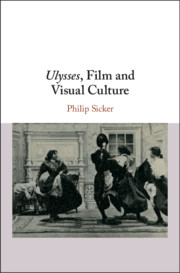
“Ineluctable visuality”: Philip Sicker’s Ulysses, Film and Visual Culture

Review by
Katharina Rajabi
Ludwig-Maximilians-Universität München (LMU Munich)


Philip Sicker. Ulysses, Film and Visual Culture. Cambridge UP, 2018. x, 276 pp. $105 hardback. $84 ebook.

Joyce’s weak eyesight and lifelong eye troubles are well known and consistently invoked to constitute the analytical framing in scholarly works on visuality in his texts (and this review is no exemption). This research into visual perception and media, steadily increasing since the “visual turn,” has repeatedly interpreted the previous relative lack thereof in the vast field of Joyce studies in the light of a possible misconception that Joyce’s poor sight resulted in the privileging of the acoustic over the visual in his writing. In contrast, scholars underlining the importance of the visual invert this conclusion, suggesting instead that Joyce’s ocular ailments indeed caused a preoccupation with perception and visuality that is undeniably present in his works.

Philip Sicker, too, begins his study by drawing on this correlation, arguing that “Ulysses, composed as Joyce’s vision deteriorated […], is his ultimate act of capturing and preserving the eye’s encounter with reality, a transaction conducted via the gazes of Stephen and Bloom and through a multitude of refractory narrative lenses” (2). His aim, then, is to illustrate the significance of visual perception, recognized as being markedly embodied and mediated, as well as of those visual media themselves and their structures and regimes, showing in detail how Ulysses is informed by optical media techniques and practices. In Joyce’s text, Sicker argues, perception and “technologies of sight” (10) constitute an epistemological mode, a specific way of accessing reality: “Far from alienating subjects from the object world and one another, the perceptual habits shaped by visual technology sometimes enable Bloom and Stephen to organize and penetrate reality more deeply” (19). His analysis of visuality in Ulysses thus focuses on its epistemological, rather than its “socioeconomic” (9) implications – in contrast to preceding studies that considered visual phenomena in context with their examinations of commodity culture in Joyce. 

Each chapter of Ulysses, Film and Visual Culture centers on a different figuration of the visual. Although the title suggests a study primarily on Ulysses and film, Sicker’s monograph provides a much more far-ranging exploration. While film is certainly central to the author’s argument, the two chapters dedicated to film (chapters five and six), based on previous articles, are supplemented and framed with – in effect even more inspiring – in-depth analyses of visual media from the diorama to the stereoscope, of the text’s philosophical reflections on the conditions of vision, and of perceptual figures and constellations from the flaneur to the act of seeing as an intersubjective experience. Building on existing scholarship and incorporating relevant theoretical positions, Sicker thus delivers, for the first time, a comprehensive account of visuality in Ulysses. 

The opening chapter, “Ineluctable Visuality: Stephen’s Ways of Seeing,” analyzes the way visual perception is conceptualized and reflected on in the first three episodes of Ulysses, with reference to optical media including the diorama and the panorama. Focusing, in particular, on “Proteus,” Sicker delineates how the discourse on perception, manifested in optical experiments and meditations on philosophical theories of vision, centering on the subject of vision and the ontological status of the perceived object, is negotiated between idealist and materialist notions. 

The second chapter, “Stephen in the Gaze of Others,” in turn, examines the reflexivity of sight, the “condition of being watched” (15), an experience central to modernist explorations of vision, incorporating the theories of Lacan and Sartre, and the panopticon as a medial figuration of this perceptual constellation, as well as placing this within the context of religion. While Sicker acknowledges that Bloom, too, constantly finds himself in the gaze of others, he does not pursue this aspect further, choosing instead to focus entirely on Stephen. Even if understandable with regard to the structure of his argument, this nonetheless seems like a regrettable omission, since the consideration of Bloom – himself famously ruminating on the gaze of the other and seeing “ourselves as others see us” – would not only be interesting in this context, but would actually support Sicker’s argument regarding the reflexivity of vision. The constellation Bloom – Boylan, especially at the end of “Lestrygonians,” or the perceptual structure of “Cyclops,” for example, would be worth further analysis against this backdrop. 

Chapter three, “Snapshots from the Pavement: Bloom as Modernist Flâneur,” turns to Bloom, reading him, with Benjamin, as figuration of the flaneur. Focusing on flanerie as an “observational practice” (13), Sicker traces its connection to commodity culture and equates it with a form of “photographic perception” (19). The fourth chapter reads “Wandering Rocks” against the backdrop of Futurist aesthetics, demonstrating how the text is influenced by Futurist conceptions of mechanics, simultaneity, perspective (from bird’s eye view to fragmentation and close-ups), movement (photodynamism), and the employment of visual analogies. In doing so, Sicker delivers inspiring new findings, as Ulysses’ connection to Futurism has not really been previously explored. 

Chapter five and six focus on film: While chapter five provides a reading of “Nausicaa” informed by psychoanalytic film theory (Mulvey, Metz) which emphasizes the constellation of gazes, their inherent power structures, and the connection of sight and pleasure with regard to the mutoscope, chapter six traces the influence of George Méliès’s trick cinema with its transformations, continuous references to dreams and its spectacle-like quality on “Circe.” Although this connection has been examined by Joycean scholarship before, Sicker, very interestingly, adds the aspect of self-watching and visual reflexivity as a common thread. The last chapter follows this up by exploring Bloom’s and Stephen’s intersubjective perception in “Eumaeus” and “Ithaca” with reference to phenomenological approaches (Merleau-Ponty, Husserl, Lévinas), parting from their shared gaze at Molly’s photograph. Sicker also retrospectively identifies moments of parallel perception earlier in the novel, thus connecting this final chapter of his study to the first one that had focused on Stephen’s gaze and conceptualization of seeing. This clever framing indicates a new accentuation of the question of perception: Instead of thinking about visual perception solely in terms of subject and object of sight, the emphasis on visual reflexivity brings into focus the act of seeing as well as the intersubjective moment. This proves to be a very interesting and productive approach, and, supported by Sicker’s very detailed, thorough, and intent reading and analysis of the text, a major strength of his study.

Because of its admirable all-encompassing conception, however, the study in other regards sometimes tends to remain on the surface and to tie in its observations too neatly with the theory, where at times reading it against the grain would perhaps have resulted in unexpected insights. This becomes especially apparent in Sicker’s analysis of “Nausicaa” where his application of Mulvey’s and Metz’s propositions does not resolve the question of Gerty MacDowell’s agency that he himself had asserted in an earlier reading (see Sickler, “Unveiling Desire”), and instead smooths over the complexity of the optical power structures in the episode. With regard to the gendered aspects of visual media – the commodification of women through pictures and the consequences this entails for desire – following up on the political and economic implications, too, would have been interesting, even if beyond the declared scope of Sicker’s more epistemological approach to the visual. Furthermore, the problem of vagueness arising from a “metaphorical” understanding of optical media that reads them as techniques or practices at times becomes evident, especially in reference to photography. The notion of identifying Bloom with the figure of the flaneur is indeed argued very compellingly, but its subsequent equation with the photographer remains somewhat debatable given the chosen examples from the text. While the mnemonic functionalization of optical impressions and the use of close-up techniques Sicker points out in his analysis provide persuasive evidence, most often it is not clear in what sense exactly Bloom’s perceptions can be termed “pictures.” In the case of photography this is particularly perspicuous, since it does appear in the text explicitly as Sicker himself writes, and so the question arises, why the actual medium is not discussed more thoroughly in this context. Although chapter seven provides a brief analysis of Molly’s photograph, the focus lies more on the act of looking at the picture than on the implications of the medium itself. 

This, however, does not away take from the immense quality of Sicker’s study that, crucially, considers the various visual media in connection with visual perception itself, thus addressing the novel’s examinations of sight in-depth for the first time, emphasizing the “ineluctable” importance of the visual in Ulysses. Identifying the turn of the text’s perceptual discourse away from “static” configurations of the status of subject and object of vision and toward an examination of visual reflexivity and intersubjectivity, is a particularly valuable finding.

Smartly structured and engagingly written, Ulysses, Film and Visual Culture closes a gap in Joyce criticism and brings valuable contributions to modernist studies with its detailed and comprehensive approach. Bringing together and structuring existing findings under the focal point of visual perception, it delivers new insights and inspiring readings of the text and will be the basis for further research into Joyce and visuality.


Works Cited

Sicker, Philip. “Unveiling Desire: Pleasure, Power and Masquerade in Joyce’s ‘Nausicaa’ Episode.” Joyce Studies Annual, vol. 14, 2003, pp. 92-131.


Katharina Rajabi (katharina.rajabi@germanistik.uni-muenchen.de) is a PhD candidate in comparative literature and research associate at the University of Munich. Her dissertation project examines the writing of photography in literary modernism, with a special emphasis on James Joyce.


Monday, March 2, 2020

Review Roundtable: Three views of Alan Singer's Posing Sex


Today we roll out a novel feature of the JML blog: a roundtable review that brings differing perspectives to bear on assessment of a single book. The roundtable’s object is Alan Singer’s provocative Posing Sex: Toward a Perceptual Ethics for Literary and Visual Art (Bloomsbury Academic, 2018). The reviewers are Charles Altieri, Robert L. Caserio, and Daniel O’Hara. If readers find this to be a stimulating format, we’ll undertake to produce it regularly!

PART 1

Charles Altieri
University of California, Berkeley

Alan Singer’s book Posing Sex: Toward a Perceptual Ethics for Literary and Visual Art is remarkably sensitive and intricate in surveying how aesthetic moments may connect to more comprehensive aspects of life by virtue of the kinds of “mindfulness” they pursue. Posing Sex treats images of explicit sexuality as demands on the imagination to take responsibility for what troubles perception. The book asks what kinds of mindfulness can offer reflections on personal experience capable of resisting the universalizing tendencies of what we inherit as “rational” principles. We are invited to realize how and why works of art in general solicit reflection on complex moments of sensuality that solicit a reasoning process capable of restoring and enriching a renewed intimacy with specific concrete situations. Sex overwhelms reflection, but it also tries to establish how mindfulness can be characterized in aesthetic experience.

Two features of this book stand out for me. The first is the range of conceptual materials Singer adapts in order to make his case. Let me cite just some of his building blocks. He takes from the Stoics a crucial identification of aesthesis with the density of perceptual feeling as it struggles for understanding. Then he supplements that point by invoking Daniel Heller-Roazen’s argument that “knowing is sensing first and that sensing is determinative for a self-revising nature” (24). Singer builds ethical concerns on perceptual ones by adapting the formulations of Heirocles, a classical Greek philosopher claiming that the discourse of sensation “constitutes the best principle for the elements of ethics” (25) because it contributes to the knowledge of first things. Singer’s fullest elaboration of the crucial link between sensation and mindfulness comes from the philosopher Alva Noe. For by Noe’s account “the ‘look’ of a perceptual object is not a relation between the thing perceived and the perceiving mind. It is rather a relation between the object and the environment in which the mind discovers itself as a perceiver, because it situates itself within an environment” (28). The mind makes those discoveries because its primary relationship to the environments is characterized by Spinoza as conative, as exploring a possible intensification of its powers as a situated being. From there Deleuze and Hegel are not far away, since despite their intense opposition, they are both fascinated by self-consciousness as the transformation of conativity into a new domain of possible powers.

Having located significant powers by means of the “proposition that every sensation of existent being is felt as a conceptualizing impulse” (13), Singer tries to align three quite different traditions enabling him to extend Noe’s view of perception as mindful to the domain where taking responsibility for how we perceive situates ourselves in a larger world. First Singer needs a way of characterizing mindfulness that stays involved in perceptions without simply abstracting them into the roles of Kantian understanding. He finds that in the concept of “conceptual blending” developed by Mark Turner and Giles Fauconnier. Such blending does not strive to resolve contradictions but dwells within them in the form of juggling mental spaces by integrating “two extraordinarily different [conceptual] inputs to create new and emergent structures, which result in new tools, new techniques, and new ways of thinking (95). Then Singer reaches out to a common sense tradition in analytic philosophy that correlates conceptual juggling, which might be utterly narcissistic, with the kinds of reason-giving for which ethical claims might be made by means of the work of processing how we sense. With some overlooking of how these figures situate themselves in distinctively philosophical debates, he finds what he needs in contemporary thinkers like Robert Brandom and John MacDowell. These figures develop models of reasoning that characterize actions rather than submit actions to the test of possible universalization by attempting “to integrate reason with animality”: the capacities that belong to reason” are “operative in our forms of responsiveness, mediated by the senses, to be features of our environment” (124).

Finally, Singer turns back to a literary context by using these philosophers to sustain one of the rare moments of criticizing other thinkers in this book. He takes on how Jacques Ranciere and Jean-Luc Nancy elaborate tensions between the sensual and the reflective orders of experience that for them justify utter suspicion of claims to the authority of reason. Singer has always been attracted to these post-postructuralist critiques of the pretensions of consciousness to mastery over event aspects of our lives. But now he thinks he can meld event with reasoning and so produce some rapprochement between immediacy and the kind of reasoning it sponsors.

The point of my introductory remarks is to elaborate how Singer deploys a unique mode of argument that we might best characterize as philosophical bricolage. The critic’s work is to find a conceptual balance between an impressive host of sources made to contour to one argument by not worrying much at all about the actual context of debate within which his authors might have characterized their work. I point this out primarily as a form of praise, since it offers a distinctive way for literary criticism to use philosophy without becoming subject to its disciplinary quarrels and the qualifications they demand. Singer’s form of theoretical bricolage is especially compelling because the demands of synthesis are also responsible for the second striking feature--the intense single-mindfulness with which he keeps repeating and modifying his central claims. Philosophy and Nabokovian obsessiveness at times vie for dominance as the text circulates through often very impressive readings of selected works by Nabokov himself, John Currin, Bronzino, Courbet, Lawrence, Kafka, and among several figures in the last chapter noteworthy encounters with Francis Bacon and Lars Von Trier.

It is high time I perform a little bricolage of my own and show how these elements come together in Singer’s theory of the powers of the sexual image. Imagine the limitations of characterizing images of sexual intensities as simply pornography. Obviously, judgments that reduce this range of images to the label “pornography” appeal to a mode of reasoning that imposes general categories. In so doing these judgments simply deny the possible fascinations and solicitations of the sensual domain. And they are blind to the complex roles sensation can play in elaborating alternative practices of reasoning based on an individual’s need to make sense of such particular experiences.

Singer would say that the judgment imposing the category of pornography is a classic instance of the residues of anthropomorphism basic to our culture. Sensations seem of little worth in themselves. Their role is to allow what seem definitive judgments made by a mind confident in its imperious role as shaping evaluations. To dismiss such imperiousness out of hand would lead to embracing the critiques of mindfulness basic to late Poststructuralism. So Singer tries instead to establish what he calls a “reverse anthropomorphism” basic to aesthetic experience and most forcefully illustrated by a very different attitude toward the sex image. In speaking of Lawrence’s concept of “cunt awareness” Singer defines reverse anthropomorphism as asking “In what way is sensation/physicality reciprocal with mindedness such that no duality is brooked and no hierarchical logic subsumes … the complexity of the problem (126). We seem “culturally fascinated with the sex images as a touchstone of self-realizing personhood that is not intelligible to itself except through the discovery of what it does not know about what it is doing” (126). The “virtue of reverse anthropomorphism animated by the sex image is precisely that it poses against absolute reason the more context-sensitive discipline of reason-giving” (199).

Think about how virtually any intense representation of the sex act initially resists the authority of the mind: with images of the sex act “participation trumps understanding” (63-65). To be moved is to find mind giving way to the immediacies of the senses. And to be moved is to wonder how much the mind can intervene in the situation—can it know what the agents are feeling? Indeed can the mind know what it is feeling since it experiences so much that appeals precisely because this is a secular version of the realm of the unknowing--now called the sublime? Yet can we be satisfied with what the senses afford? Singer argues that we want to know how people are thinking as a means of participating in these immediacies. We want to figure out better how and why we ourselves are moved by such encounters. While we see the limitation of imposing categories on events, we can turn from judgment to the giving of reasons that simply try to clarify how one can build on, and build in what one is experiencing. Such thinking may even extend to domains like the aesthetic in general, where one tries to align the mind with how the senses position us. And such thinking may have a significant moral dimension because it is our means of sharing with other people the felt distinctiveness of such situations ( e.g. 161).

 I have three basic quarrels with Singer’s argument. First I find it hard to make Singer’s transition from Spinoza’s conatus as “the existential locus of human striving toward explicability” (113), where “self-explanation is indistinguishable from self-perpetuation,” and any genuine interest in the reasons offered by others for how they engage the immediacies of startling events. That response to art is self-absorbed no one can doubt. That one uses these self-absorbed responses as somehow enterprises enhancing sociality seems wishful and willful. It is as if China could recognize that its one-child policy had created millions of narcissists and then demand reorientation toward community.

My second objection involves Singer’s use of the concept of reasoning as his bridge between the self-absorbed self-reflection and an ethical effort to exercise concern for how others might respond to what moves them beyond traditional reasons. He seems to want at once something like the transpersonal authority of classical ideas of the power of reasons and the personal expressiveness of reasoning as self-illumination. While he does discuss these different kinds of reasons (e.g. 47-50 and the brief passages from MacDowell), I cannot find any careful description of how Singer’s personal reason-giving satisfies the processes of managing evidence that our culture has come to require for any stable sense of addressing what can be a world in common. Analogously, I cannot find good arguments for why aesthetics is necessarily involved with reasoning at all. Even Kant does not attribute reasons to aesthetic experience but to the work of justifying approval, a very precise specification of a kind of reasoning that is not addressed to personal intensities but to properties of the art work. Why is talk about personal experience not just chit-chat that Singer inflates into a category with moral resonance? Why are not pointing or smiling significant modes of extending one’s aesthetic appreciation to other people?

It is not as if philosophers have not worried about kinds of reasons capable of breaking the hold of universals. Bernard Williams offers a powerful case for distinguishing the reasoning that makes for honest self-description from any kind of setting of imperatives appealing to Reason for their authority. But to accept Williams would involve surrendering the social power Singer wants to claim for even his “clarifying reasons.” For Williams the giving of reasons comes close to personal therapy. For Singer the giving of reasons tries to bridge the gulf between narcissistic reflection and identification with communal projects. He has the large task of both deploying and resisting a sharp contrast between reasons that a person deploys to clarify a subjective state and reasons that involve moral dimensions because they are somehow invitations to shared processes.

Ironically, the closest Singer comes to providing a picture of mind that can admit different kinds of mental states is when he talks about Turner and Fauconnier’s complex balancings:

Fauconnier and Turner go on to explain that “double scope” blending “gives us
the supremely valuable, perhaps species defining cognitive instrument of
anchoring other meanings in a highly compressed blend that is like these
immediately apprehensible basic human scenes, often because such scenes
are used to frame the blend. (197)

But here he does not speak of giving reasons at all. In fact this discussion seems to praise Turner and Fauconnier for repeating something very close to how I. A. Richards spoke about the functions of art—now generalized to how the mind can work. Complex balancings seem to me emblems for what cannot get into our reasoning but require training in modes of attunement that involve presences and not substitutes in the realm of ideas. In his closing page, Singer speaks of the aesthetic as “providing transitions to a plurality of formal orientations” (200). I wish the book had recognized how much distance there is between these orientations and our efforts to reason ourselves to what makes us engaged in such situations.

My third problem involves a limitation in how Singer approaches his specific examples of what happens in the posing of sex images by his variety of figures. I think there are big differences between the dynamic involved in our engaging moments of sexual intensity and the forces at work in our responses to the self-consciousness staging of those moments in works of art—a difference that may justify aligning aesthetic experience not with the event of perception but with how perception is rendered in accord with what artists compose as possible experiences (or experiences of possibility). Singer wants to make a universal case about the moral implications of how we respond to posing sex. So he keeps showing the same logic in various works of art and then claiming that this provides a model for aesthetic experience. But if we attend to how artists stage images of sexual union for various artistic purposes, we are confronted with a demand to appreciate why the individual artist produces this specific concrete composition. When one engages images of sexual union in practical contexts, it is feasible feel what Singer develops beautifully—one must account for the threat to one’s powers of understanding. But when one finds these images in works of art, it is not sufficient to treat each work as an instance in a general theory of how sexual images affect us. I think that Currin always and Updyke in the passage Singer quotes are acutely and irritatingly self-conscious about how they stage sexuality. So much artistic effort completely denaturalizes the event, so that one needs very different frameworks for appreciating how they handle staging what is at stake in their particular renderings of sexuality.

Perhaps it is not necessary to add in conclusion my hope that these comments suggest that aesthetics is always a matter of authorial staging, so no analogues from what the works represent will afford much help in theorizing what works have in common. Theorizing art may be a matter largely of developing sensitivity to what various stagings can accomplish as invitations to a mindfulness thriving on its distance from how we typically perform reasoning.

PART 2

Robert L. Caserio, JML co-editor
The Pennsylvania State University

Less and less has “aesthetics” mattered to writers and artists, and to humanities departments and museums. The term’s potential reference to “beauty,” on the supposition that beauty is universally recognizable, has long discredited it, of course. But more recent attempts to recover it, in post-modernist refinements of sublimity and indeterminacy (as in Lyotard’s The Inhuman) or in Marxist-oriented elaborations that rely on an indirect relation of artworks to actuality (as in Adorno’s Aesthetic Theory, or Lukacs’s Die Eigenart des Ästhetischen [The Special Nature of the Aesthetic], or Marcuse’s The Aesthetic Dimension), have become fading influences. The change has come about in the name of “politics,” which requires of writers, artists, and audiences feelings that are far more urgent than they are “aesthetic.” The “political” claim now is that “agency” and the impact of “artists” and their consumers must be enlarged, so that “art” be not distanced from determinate social purposes, and so that “action” be made identical with activism. The change is so widely established that it amounts to a cultural revolution, although it has its forebears: in Stalinist demands for socialist realism, for example—demands for the political usefulness of the arts, which appear to be impotent or irrelevant if they have no immediate practical effect.

A leading virtue of Alan Singer’s Posing Sex is its commitment to a theorization of literary and visual art that might please even the opponents of aesthetics. Those partisans will find no shrinking from action here: “prospective agency,” “doing” and “activity” (152) are among Singer’s watchwords. That is the case, even though erotic passion, and art’s representation of it—art’s posing of it, as Singer says—is the pivot on which Posing Sex turns. We might expect eros, the pivotal phenomenon, to indicate a passional state rather than a decisively active one. But for Singer the pathos of eros, whether considered as a captivation by desire or as an inspiration for art (“the spectacle of the ecstatic body,” 155) is only one side of the matter. The other side is action-oriented.  Singer thereby echoes Hegel’s Aesthetics, which defines “pathos” as “the essential rational content which is present in man’s self and fills and penetrates his whole heart,” and which is inseparable from human “decision and action” (I, 232). Equally inseparable from the latter, Singer thinks, are sexual desire’s stirrings. So he posits that a rational aspect of pathos inheres in eroticized motions of consciousness, and that it inheres too in art’s evokings of them. In sum, Posing Sex proposes that, whether eros or art is at issue, neither mind nor action goes by the board.

Among the illustrations that Singer brilliantly adduces for his argument is the Earl of Rochester’s poem “The Imperfect Enjoyment.” The poem conjures up the poet’s premature ejaculation, effected merely by the sight of his mistress’s body. Rochester vituperates his penis for making him suffer a humiliation of his will; indeed, he rails against his uncontrollable corporeal being in general. Yet the pathos of Rochester’s erotic suffering, Singer argues, is also actively productive: pathos, rather than a surrender to what is unintelligible, stimulates Rochester’s self-consciousness, and initiates the poet’s elaboration in verse of his feelings and thoughts.

The dynamic passive-active dyad in Rochester’s case illustrates what Singer calls “mindedness” (3), which he hypothesizes is the inevitable universal fruit of sexual positings. “By mindedness I mean,” Singer explains, “that which sustains our involvement in the world without capitulating to brute natural necessity” (3). Brute necessity arguably includes the throes of erotic desire, by which mind might seem to be “decisively obliterated” (3). But to the contrary, according to Singer, in life, or in early modern instances such as Rochester’s, or in modernist writing and visual art, decisive obliteration is not mind’s fate. Such obliteration is assigned to modernist works by conventional literary and art criticism. Posing Sex strongly opposes that conventional view. One value of Singer’s literary-critical iconoclasm lies in his ability to bring into the domain of mindedness and action texts that range from Lady Chatterley’s Lover to Henry Miller’s Sexus to Lolita; and to do the same for erotically-charged visual art by Balthus or Bacon or John Currin, and for the film art of Lars Von Trier.

In recommending the value of Posing Sex, I think it is important to point out that Singer’s appeal to rationality does not mean that he mines artworks in order to wrest from them abstractly formulated “ideas.” “Mindedness” is subordinate, he says, to “my insistence on the inextricability of mind and body” (3). That insistence, he says, is not only his: he takes it to be art’s and eros’. Their witness of an inextricable relation, Singer argues, should inhibit any response that would derive abstract ideation—or abstract ideology—from them, or would subordinate or sacrifice mind to body or body to mind. The mind-body relation is a dialectical, open-ended one.

Singer sees the openness as part of a continuum that ties individual erotic or aesthetic response to interpersonal contexts, and by extension, to social ones. He connects “mindedness” with what he calls “our most urgent threshold of intelligibility”: “personhood” (3). And he proposes that “the sex image” in art (considered as a paradigm of “the aesthetic”) models personhood not as a fixed entity, but as an unresolved exploration of mysteries that baffle the mind, and of a mindedness that always seeks to think those mysteries through. Mindedness is a kind of thinking that is more than a “romancing [of] indeterminacy” (147). Elaborating on inadequate responses to art’s incitements to personhood, Singer notes that “a curious feature of the intentionally posed, aesthetically composed sex image [is that it] refuses access to the mysterious interiority it tempts us to enter: bodies are not doors mounted on logical hinges through which we might discover our personhood with a straightforward sensuous push” (196).  In other words, the best access to the allure of art or sex or personhood is by way of reasonings that are not merely logical, and emotions about them that are not merely or straightforwardly “felt.”  This indirect give-and-take suggests that any personhood is constituted by a perpetual dialogue of thoughts and feelings about its founding internal mysteries; and, likewise, that interpersonal relations, or social relations generally, are similarly constituted.

Must Singer’s theorizing of art necessarily reach for social relevance? Numerous such theories from Schiller to Dewey do just that: Singer’s reaching is impelled by a powerful tradition.  Moreover, Posing Sex is obliged to extend its range if it is to engage the opponents of “aesthetics,” given the sociopolitical measures of relevance that motivate the opposition. Here again, as with “action,” Singer offers dissenters a common ground. He agrees with them that art is publicly, politically serviceable. But one component of Posing Sex might well obstruct acceptance of his offer. Because Singer argues that personhood and social being remain dynamically unresolved, in his view neither art nor eros can ratify counter-arguments rooted in already-decided personal or group identities. That is to say, if individuals or social groups believe they possess fixedly identifiable “personhoods,” and if in the name of “politics” they look to art and eros to confirm that fixity, they will foreclose open engagement with both. They will miss arts’ and eros’s essential attractions, and they will avoid the sentient thoughtfulness they stimulate.  Posing Sex persuades me that we do not want to risk that loss and evasion, all the more so because the counter-arguments at issue underwrite the cultural revolution I began by mentioning. One of the best resistances to that great change is Singer’s persuasive disclosure of the shared character of the diverse texts and visions he gathers into an eros-inspired unity.  By virtue of being a formidable bloc of creations, the artworks traversed by Posing Sex bear witness that an inquiry into aesthetics remains a justifiable intellectual endeavor, indeed a foundational discipline, an unfailing lure for mindedness.

Works Cited
Hegel, G. W. F. Aesthetics: Lectures on Fine Art. Volume I. Trans. T. M. Knox. Oxford: Clarendon Press, 1998.

PART 3

Daniel T. O’Hara, JML co-editor
Temple University

I watch those TV shows where people seek to relocate to warmer climes, often in remote places, and if they have enough money for the purchase, on their own desert islands. Clearly, this is compensatory wish-fulfillment, as Dr. Freud might advise, and I should at 71 have long ago grown out of it, but did not. On one such show recently, the would-be home/island owner, having been left by the realtor to explore on his own the small island he might purchase, turned a corner of some palm trees to discover to his surprise rows of flowers, of all sorts. The would-be home/island owner immediately shouted out: “How beautiful!” And, as immediately, began to propose different reasons for why the neat rows of flowers might be there, reasons we can all imagine for ourselves. This experience of the beautiful, and of the surprise at perceiving it and the subsequent repeated proffer of reasons for it, makes for a typical set of features, a pattern of significant response, for any post-Kantian theory of aesthetic beauty. Whether this pattern is identified as “circular” or “dialectical” is a matter of taste for the theoretician.

Similarly, in watching Deadliest Catch, a TV show about catching huge crabs during the winter months on the Bering Sea, I am shocked each season by the sublime effects of thirty and forty foot high waves, enough so that each time I see them rise up about to strike a boat, I swear I will not watch this show again. Such roiling moments fill me with terror, even though by the time any new season returns, I know all about what has basically happened, at least in a general way, so that there is, perhaps, no good rationale for my terror. Such shocking moments presented by the show, though mediated by the medium of representation and my safe distance in time, space, and knowledge, from the sheer materiality of these moments, constitute the basis of any post-Kantian theory of the sublime.

With the surprise of beauty and the shock of the sublime, we have a critical framework for what analyzing the aesthetic experience: whether it is nature or the imagination of the artist producing beauty and the sublime, such aesthetic events produce a break in our experience, at least momentarily, that inspire or provoke our creation and offering of reasons, to ourselves and to others, for what has happened, why it has happened (if we can fairly speculate so), and how we value these aesthetic moments of surprise and shock, of beauty and the sublime, in particular and general, equally alike.

Of course, what Alan Singer calls “the sex image” in his new book of aesthetic theory Posing Sex is a radical form of the sublime experience, which he treats as such several times therein, and it is a challenge to creating and offering reasons, due to the moralizing effects of social conventions in reaction to violent challenges to cultural mores. Singer presents his new theory of staging the sex image in creative productions--literary, artistic, and cinematic--to alleviate this sore spot in critical theory. As Charles Altieri notes, Singer’s “philosophical bricolage” in satisfying this need in post-Kantian aesthetic theory is admirable, and for me, breathtaking. It is the sublime in itself, to modify Pope on Longinus. And I won’t wade into the potential minefield of traditions in post-Kantian aesthetic theory and opine one way or the other on how rigorous the debates in these traditions have been treated by Singer in the production of his “theoretic bricolage,” as Altieri’s review begins to do. To do so would only duplicate that critical move in its distraction from the book itself or its potentially self-serving implication, if one has published stakes in those traditions. Instead of such side issues, I want to celebrate Singer’s ability to respond critically to Lars Von Trier’s controversial film Antichrist (2009), as an instance of Singer theory at work in its finest mode.

For reasons of space, I am focusing on what Singer has to say in response to the opening shot of the film, from its Prologue. This shot is a montage of two basic scenes. One is that of two adults performing robust, even rough, sexual coitus and related once upon a time so-called perverted acts, while the second is that of a young child moving to the window of his bedroom on this same cold crystalline night, opening the window, and stepping out and sailing into the air as to fly away twenty-five feet off the hard terrace of the same house where the parents are, as it might be said, blindly going at it. The rest of the film “flows” and jumps alike from this shocking, even traumatic, juxtaposition as the couple spiral ever downward into violence, mutilation and self-mutilation, and death, due to their, especially the woman’s, inability to create responses with the man (one rightly assumes they are husband and wife, the parents of this poor boy). Guilt is so painful it fails to provoke mindfulness but instead produces mindless, frenzied sexual activity, an even more extreme variant of the very experience that led to the original tragic contingency in the first place. Here we have a perfect case of the sexual sublime, underscored by the supplementation of the sex image by the unintentional suicide of the child, as if in the opening montage of the film we have the sublime experience and its perfect sublime critical commentary all in one, especially since later in the film an absurdly talking fox makes it clear that this cinematic world is surely sheer chaos.

Here, however, is Singer mindfully beginning to address his analysis of this difficult film:

The specific shock that Von Trier wreaks upon his audience in Antichrist has precisely to do with an interest in realizing human capacities through incapacity: the incapacity of human bodies suffering physical and emotional pain. I take the unprepared for obtrusion of the sex image in the opening scene of Von Trier’s film as a particularly strategic point of departure. The pretext is tragedy. But the mindedness that is elaborated through suffering opens upon a wider horizon. The shock with which Von Trier teases an impossible recognition for the audience involves the juxtaposition of two simultaneous scenes of action. (191)

What we see here is only the tip of what Singer can do with this film. I would urge readers to follow up, for another few pages, and see. That is, I urge them to “taste and see” for themselves, and in the reading of the entire book when they come upon these pages they will experience the surprises of informed and just critical judgments and the shocks of new aesthetic experiences.