Welcome to the Journal of Modern Literature news and information site.


Check here for updates about our latest issues, calls for papers, submission guidelines and tips, as well special online-only content. Our issues themselves are available at Project Muse and are archived on JSTOR . Check out the "Read for Free" page to enjoy some featured content.


More than four decades after its founding, the Journal of Modern Literature remains a leading scholarly journal in the field of modern and contemporary literature and is widely recognized as such. It emphasizes scholarly studies of literature in all languages, as well as related arts and cultural artifacts, from 1900 to the present. International in its scope, its contributors include scholars from Africa, Asia, Europe, North America, Oceana, and South America.

Wednesday, June 30, 2021

Book News: Examining "the crowd" in modern literature

Modernism and the Idea of the Crowd

BY JUDITH PALTIN  

Cambridge UP, December 2020

Hardback ISBN: 9781108842235

https://www.cambridge.org/us/academic/subjects/literature/english-literature-1900-1945/modernism-and-idea-crowd?format=HB


This book argues that modernists such as James Joyce and Virginia Woolf engaged creatively with modernity's expanding forms of collective experience and performative identities. Judith Paltin compares patterns of crowds in modernist Anglophone literature to historical arrangements and theories of democratic assembly to argue that an abstract construction of the crowd engages with the transformation of popular subjectivity from a nineteenth-century liberal citizenry to the contemporary sense of a range of political multitudes struggling with intersectional conditions of oppression and precarity. Modernist works, many of which were composed during the ascendancy of fascism and other populist politics claiming to be based on the action of the crowd, frequently stage the crowd as a primal scene for violence; at the same time, they posit a counterforce in more agile collective gatherings which clarify the changing relations in literary modernity between subjects and power.

BOOK NEWS is an online-only feature announcing new publications in modernist and contemporary literary studies. These announcements do NOT constitute an endorsement by the Journal of Modern Literature.

  • Examines and analyzes crowds, political agency, and group performativity across a set of canonical and lesser known modernist works
  • Offers a comprehensive anatomy of the social mind as theorized from within modernist studies, democracy studies, and literary studies
  • Engages with a variety of period archives including fiction, drama, poetry, music, painting, newspapers, police and government records, published correspondence, manifestos, private writings, and exhibitions

Judith Paltin is an assistant professor in the Department of English Language and Literatures at the University of British Columbia. She has published articles in the James Joyce Quarterly, The Conradian, Conradiana, The Wildean, and ISLE, and a chapter in Affective Materialities: Reorienting the Body in Modernist Literature (2019).

Tuesday, June 22, 2021

Post-Criticism? A review of Harold Schweizer's On Lingering and Literature

BY DANIEL T. O'HARA 

Temple University
and JML co-editor 


Harold Schweizer. On Lingering and Literature. Routledge, 2021. 124 pp. $59.95 hardcover. 

I take my title question from the book’s self-description: “Drawing on a wide range of philosophic and literary texts and examples, [this book] exemplifies in its style and accessible argumentation the new genre of post-criticism, and aims to reward anyone interested in slow reading, daydreaming, or resisting our culture of speed and consumption” (i). Intrigued by the “post-criticism” lure, I have decided to review it, even though I do not like the use of “post.” I was antsy with it even when I was associated with a journal whose former subtitle included the term “postmodern.” (By the way, the best “post” title or subtitle was that of a Duke series: “post-contemporary.” You cannot go beyond that, unless one goes straight into the pure past.) 

The best way to encapsulate the argument of this throwback phenomenological study of the aesthetic quality of lingering and its component relationship to literary experience (creative and appreciative) is to cite Emily Dickinson, poem #657, as the book does on page 70:

I dwell in Possibility— 

A fairer House than Prose— 

More numerous of Windows— 

Superior—for Doors—.

As Gaston Bachelard might say—his books are cited approvingly throughout the book, especially On Poetic Imagination and Reverie (1971)—lingering is not waiting, which as Schweizer’s last book On Waiting argues, is a state of ever awaiting action, one’s own, or another’s, as it bears on oneself. Beckett’s hapless clowns in Waiting for Godot while away the time but act as if they would prefer Godot to come to end their endless, pointless playing, since they cannot decide, it appears, to do so for themselves. Instead, as Schweizer rehearses here, lingering is indeed dwelling almost self-indulgently, even almost auto-erotically luxuriating, in possibilities, bathing in imaginative potential, no matter how strongly moved we are by this quality to make a definitive response. 

We could describe Hamlet as possessed by lingering, perhaps, but this anxious indecisiveness is not the idea Schweizer wants the reader to take away from his book. The prolonged and delightful immersion in the aesthetic dimensions of experience is what he wants us to think of first and most of all. Given that Schweizer is a well-published poet— The Book of Stones and Angels (2015), Miriam’s Book (2017), and The Genealogy of Elevators (2018)—I immediately think of that moment leading to imaginative vision which inaugurates and shapes a poetic work of art, lyric poems particularly. 

Such lingering in inchoate temporality is like what Keats calls famously in a 1817 letter “negative capability.” The difference from lingering is that Keats’s quality is the distinguishing feature of a poet of distinction, such as Shakespeare, and so, more definitively marked as ideal in its potentiality than mere everyday lingering. In fact, Schweizer cites Benjamin from “The Image of Proust” (1938) precisely on this everydayness (28-29), and cites Adorno on lingering’s astounding aping of the Creator’s “Sabbath gaze” (34-36), when after six days of creating from nothing—hard work indeed!—God rested. In this romantic and metaphysical combination of the ordinary and the supra-ordinary, we can also hear an allusion to the would-be secular miracle of Wordsworth’s visionary quest, that sense sublime of something evermore about to be. 

The book’s chapters most engrossing for me are six through ten, which are, respectively, on the temporality of Whitman’s grass; the ecstatic slowness of Rilke’s looking; Woolf’s indescribable pause, particularly in Mrs. Dalloway (1925), when Clarissa Dalloway notes a falling drop; Proustian interludes of all kinds, especially in the first three books of In Search of Lost Time; and the paradoxical empty weightiness of Sebald’s presentation of time throughout his four hybrid fictional memoirs, with The Rings of Saturn (1998) and Austerlitz (2001) receiving the most attention. 

Schweizer is specifically attuned, following Sebald’s lead, to the opposition between the forgetting and remembering of the dead. He opens “The Weight of Sebald’s Time” chapter by quoting The Rings of Saturn where it quotes Thomas Browne’s Urn Burial (1658): “To set one’s name to a work gives no one a title to be remembered, for who knows how many of the best men have gone without a trace?” (93). Schweizer then quotes the narrator’s lament in Austerlitz:

. . .  how little we can hold in mind, how everything is constantly lapsing into oblivion with every extinguished life, how the world is, as it were, draining itself, in that the history of countless places and objects which themselves have no power of memory is never heard, never described or passed on. (Qtd. in 93) 

Lapsing into oblivion is less a past or future state than the eternally moving present in Sebald’s fictions. 

Mrs. Dalloway in her novel reflects as she sits down to her dressing table in the morning on time’s passage, and reads her current fate in her created image for the moment as a falling drop she dives into the day to hold it tenderly in her close attention:

She was not old yet. She had just broken into her fifty-second year. Months and months of it were still untouched. June, July, August! Each still remained almost whole, and, as if to catch the falling drop, Clarissa (crossing over to the dressing table) plunged into the very heart of the moment, transfixed it, there—the moment of this June morning . . . . (Qtd. in 64)

This is the essence of On Lingering and Literature: Clarissa Dalloway’s savoring of the moment and all its chosen and contingent experiences, including its passing. Schweizer explains: 

The inversion of time and duration, of narrative and lyric time is here represented en miniature. Clarissa’s inner life dominates the brief narrative of this paragraph to such an extent that the visible, external action—“(crossing to the dressing table)”—needs to be mentioned only in parentheses. Compared to the temporality of “the moment of this June morning, the spatial crossing of the room and table, appear banal and merely circumstantial. While the paragraph exemplifies the modernist novel’s focus on duration rather than spatial linearity, this duration only emerges as Clarissa abandons her fixation on measurable time, the years and months of her life, and yields to “the very heart of the moment." (64) 

I do not know if informed and appreciative reflection on such formative moments of literary inspiration constitutes a new genre of post-criticism, especially if one remembers Woolf’s beloved predecessor Walter Pater and his once famous collection of essays Appreciations (1889), but I am happy to embrace this volume closely for its accessible insights and considerable achievements of style.

----

Daniel T. O’Hara, emeritus professor of English and humanities at Temple University, is the author of nine books, including Virginia Woolf and The Modern Sublime: Invisible Tribunal (Palgrave/Macmillan: 2015), and editor or co-editor of six collections, most recently Humanistic Criticism: A William V. Spanos Reader (Northwestern UP, 2015). 


Friday, June 18, 2021

Book News: The lecture tour as a mover of modernism

Transatlantic Modernism and the US Lecture Tour
BY ROBERT VOLPICELLI


Oxford University Press, 2021

ISBN: 9780192893383

https://global.oup.com/academic/product/transatlantic-modernism-and-the-us-lecture-tour-9780192893383?cc=gb&lang=en#

SAVE 30%
Order online at 
www.oup.com/academic 
with promo code AAFLYG6


Many Americans' first encounter with international modernism came, not on the page, but in person—through the widespread phenomenon of the US lecture tour. Attending to these encounters, Transatlantic Modernism and the US Lecture Tour reroutes our understanding of modernism away from the magazines and other mass media that have so far characterized its circulation and toward the unique form of cultural distribution that coalesced around the tour.

Offering many new and compelling archival insights, this volume works across an admirably broad cultural landscape to reveal the US lecture tour as a primary mover of modernism. The study highlights the role this circuit played in the formation of transatlantic modernism by following a diverse group of authors—Oscar Wilde, W. B. Yeats, Rabindranath Tagore, Gertrude Stein, and W. H. Auden—on their whistle-stop tours across America, illuminating in the process how this extremely physical form of circulation transformed authors into object-like commodities to be sold in a variety of performance venues. Moreover, it shows how these writers responded to such wide-ranging distribution by stretching their own ideas about modernist authorship. In doing so, Transatlantic Modernism and the US Lecture Tour adds to a critical tradition of exposing those popular dimensions of modernism that far exceeded its standard coterie definition while also uncovering something else: how the circuit's particular diversity of social contexts forced modernists to take on a new authorial flexibility that would allow them to make in-roads with practically any audience—elite, popular, and everything in between. 

BOOK NEWS is an online-only feature announcing new publications in modernist and contemporary literary studies. These announcements do NOT constitute an endorsement by the Journal of Modern Literature.

Robert Volpicelli is an assistant professor of English at Randolph-Macon College where he specializes in transnational modernisms and modern poetry. His essays on modernist literature and culture have appeared in such journals as Textual Practice, NOVEL, and Twentieth-Century Literature, among others. He also co-edited a recent issue of College Literature on the topic of "Poetry Networks."

Friday, June 11, 2021

Remembering Sheldon Brivic, 1943-2020

 By Daniel T. O’Hara, JML Co-Editor 

We are saddened to report that Sheldon (Shelly) Brivic, a JML advisory editor since the 1970s, retired Temple University English professor, and a Joyce and modern fiction specialist of considerable renown, died on November 29, 2020, at the age of 77. 


Another retired former colleague, close friend and JML advisory editor, Alan Singer, had heard the news and alerted me. Prior to his death,  Brivic had voluntarily been living with his wife Barbara, who had been ill with Alzheimer’s, in Sunrise of Lafayette, an assisted living facility specializing in memory care.

When I googled his name to learn more details, I was still in a bit of a shock. Thanks to Google, one of the items popping up was a 2019 letter to the New York Times, which I will quote in full as it is characteristic of Brivic: succinct, corrective, and objective.

March 22, 2019

‘Good Bait’

To the Editor:

James McBride’s fine review of the magnificent Toni Morrison’s “The Source of Self-Regard: Selected Essays, Speeches, and Meditations” (March 3) refers to “the swing-era song ‘Good Bait,’ made famous by Count Basie.” Basie recorded “Good Bait,” but it was composed by the pianist Tadd Dameron, who has not received enough credit for being one of jazz’s greatest Composers.

Sheldon Brivic 

Lafayette Hills, PA   


This is not to say Shelly, as he was affectionately known by all, was lacking affect. He was subtle at self-expression, as in the last sentence here, with this reader thinking “shouldn’t any reviewer of this book know whereof he speaks concerning ‘Good Bait’ and its composer when it is a matter of pride in achievement by Morrison, African-American Nobel Laureate and should be so for James McBride, the nearly as well-known African-American writer, memoirist, and reviewer?” Shelly just states the facts, however, and leaves the ramifying implications, emotional and intellectual, to sort through, to us and McBride.

This was the same style Shelly expressed in his books, most (5 of the 7 scholarly monographs) on Joyce from a psychoanalytic perspective, including Joyce Between Freud and Jung (1980), Joyce the Creator (1985), The Veil of Signs: Joyce, Lacan and Perception (1991), Joyce’s Waking Women: A Feminist Introduction to Finnegan Wake (1995), Joyce through Lacan and Zizek (2008). The two other critical theoretical books he authored  are Tears of Rage: The Racial Interface of Modern American Fiction: Faulkner, Wright, Pynchon, Morrison (2008) and  Revolutionary Damnation: Badiou and Irish Fiction from Joyce to Enright (2017). Stealing: a Novel in Dreams was published in 2019 (JML’s review is available HERE). This JML blog got its start housing this review of Shelly’s novel. 


As a long-time JML advisory editor, Shelly did yeoman duty with evaluating submissions and reviewing new books in his field, as well as publishing articles himself. For example, in "Revolutionary Joyce" he reviewed a new book, The Strong Spirit: History, Politics, and Aesthetics in the Writings of James Joyce, 1898–1915, by Andrew Gibson (JML 38.2, Winter 2015, pp. 183-190); and in "Residual and Emergent Cultures in Joyce Studies" he reviewed several important new books, expanding Joyce Studies: Semicolonial Joyce by Derek Attridge, Marjorie Howes; Ulysses: En-Gendered Perspectives: Eighteen New Essays on the Episodes by Kimberly J. Devlin, Marilyn Reizbaum; Chaos Theory and James Joyce's Everyman by Peter Francis Mackey; Joyce's Book of Memory: The Mnemotechnic of Ulysses by John S. Rickard; Joyce and Hagiography: Saints above! by R. J. Schork (JML 23.3/4, Summer 2000, pp. 575-581). His latest article in the journal was "The Lacanian Phallus and the Lesbian One in Wharton's 'Xingu'” (JML 35.2, Winter 2012, pp. 25-36).

Fifteen years ago, Shelly appeared with me and a then recently graduated PhD student of mine Gina MacKenzie (now associate professor and associate dean at Holy Family University and a current JML advisory editor) on an MLA Panel about Lacanian approaches to modernism. Gina and I discussed, from a Lacanian revised perspective on the drive, how some of Wallace Stevens’s so-called “poems of death” enacted shy solicitations of Death by a nearly fulfilled old Eros—only lacking this last Beloved to seal the deal with the Real, as it were. For his part, Shelly was discussing how Lacan and Zizek made him see Morrison’s fiction anew, as so many “tears of rage” as in the song of the title by the Band (co-written by its lead guitarist Robbie Robertson and Bob Dylan). What united us few in life then, and so many more now in this pandemic land’s death-in-life, is clearly a community of feeling enjoying rare pleasures in intellectual loves. Tears of rage may be tears of  grief, as the song puts it, but they are so only because they are first of all tears of love.  Shelly Brivic is a greatly missed colleague and friend.  

Wednesday, June 2, 2021

Book News: 50% off Irish Studies sale from Syracuse UP


Until July 1, 2021, Syracuse University Press is offering 50% off all its Irish Studies titles when you use the discount code 05Summer.  

Their full catalog of Irish Studies titles is available HERE 

Monday, May 24, 2021

Book News: New approaches to Flannery O'Connor

Reconsidering Flannery O’Connor

EDITED BY ALISON ARANT AND JORDAN COFER

Afterword by Marshall Bruce Gentry


University Press of Mississippi, 2020

ISBN 978-1-4968-3180-4

Paper $30.00

https://www.upress.state.ms.us/Books/R/Reconsidering-Flannery-O-Connor2


The National Endowment for the Humanities has funded two Summer Institutes titled “Reconsidering Flannery O’Connor,” which invited scholars to rethink approaches to Flannery O’Connor’s work. Drawing largely on research that started as part of the 2014 NEH Institute, this collection shares its title and its mission. Featuring fourteen new essays, Reconsidering Flannery O’Connor disrupts a few commonplace assumptions of O’Connor studies while also circling back to some old questions that are due for new attention.

BOOK NEWS is an online-only feature announcing new publications in modernist and contemporary literary studies. These announcements do NOT constitute an endorsement by the Journal of Modern Literature.

The volume opens with “New Methodologies,” which features theoretical approaches not typically associated with O’Connor’s fiction in order to gain new insights into her work. The second section, “New Contexts,” stretches expectations on literary genre, on popular archetypes in her stories, and on how we should interpret her work. The third section, lovingly called “Strange Bedfellows,” puts O’Connor in dialogue with overlooked or neglected conversation partners, while the final section, “O’Connor’s Legacy,” reconsiders her personal views on creative writing and her wishes regarding the handling of her estate upon death. With these final essays, the collection comes full circle, attesting to the hazards that come from overly relying on O’Connor’s interpretation of her own work but also from ignoring her views and desires. Through these reconsiderations, some of which draw on previously unpublished archival material, the collection attests to and promotes the vitality of scholarship on Flannery O’Connor.


"Enlightening and insightful new approaches to the study of this influential southern writer" —Melanie Dragger, The Literary House Review


"Alison Arant and Jordan Cofer’s collection of essays, Reconsidering Flannery O’Connor, stands as a major achievement, presenting a number of provocative new ways to interpret O’Connor and her work, mostly by younger scholars whose work here establishes them as important voices in O’Connor criticism. Impeccably edited, the volume is a treasure trove for both general readers and seasoned critics of O’Connor, the essays consistently invigorating and enlightening." —Robert H. Brinkmeyer Jr., author of The Art and Vision of Flannery O’Connor and The Fourth Ghost: White Southern Writers and European Fascism, 1930–1950


ALISON ARANT is associate professor and department chair in English at Wagner College on Staten Island in New York City. Her work has appeared in Flannery O’Connor Review, Modern Fiction Studies, Mississippi Quarterly, and Southern Literary Journal. 

JORDAN COFER is associate provost and professor of English at Georgia College. He is author of The Gospel According to Flannery O’Connor and coauthor of Writing the Nation: A Concise Introduction to American Literature 1865 to Present

Wednesday, May 19, 2021

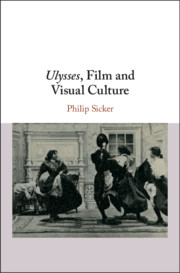
“Ineluctable visuality”: Philip Sicker’s Ulysses, Film and Visual Culture

Review by
Katharina Rajabi
Ludwig-Maximilians-Universität München (LMU Munich)


Philip Sicker. Ulysses, Film and Visual Culture. Cambridge UP, 2018. x, 276 pp. $105 hardback. $84 ebook.

Joyce’s weak eyesight and lifelong eye troubles are well known and consistently invoked to constitute the analytical framing in scholarly works on visuality in his texts (and this review is no exemption). This research into visual perception and media, steadily increasing since the “visual turn,” has repeatedly interpreted the previous relative lack thereof in the vast field of Joyce studies in the light of a possible misconception that Joyce’s poor sight resulted in the privileging of the acoustic over the visual in his writing. In contrast, scholars underlining the importance of the visual invert this conclusion, suggesting instead that Joyce’s ocular ailments indeed caused a preoccupation with perception and visuality that is undeniably present in his works.

Philip Sicker, too, begins his study by drawing on this correlation, arguing that “Ulysses, composed as Joyce’s vision deteriorated […], is his ultimate act of capturing and preserving the eye’s encounter with reality, a transaction conducted via the gazes of Stephen and Bloom and through a multitude of refractory narrative lenses” (2). His aim, then, is to illustrate the significance of visual perception, recognized as being markedly embodied and mediated, as well as of those visual media themselves and their structures and regimes, showing in detail how Ulysses is informed by optical media techniques and practices. In Joyce’s text, Sicker argues, perception and “technologies of sight” (10) constitute an epistemological mode, a specific way of accessing reality: “Far from alienating subjects from the object world and one another, the perceptual habits shaped by visual technology sometimes enable Bloom and Stephen to organize and penetrate reality more deeply” (19). His analysis of visuality in Ulysses thus focuses on its epistemological, rather than its “socioeconomic” (9) implications – in contrast to preceding studies that considered visual phenomena in context with their examinations of commodity culture in Joyce. 

Each chapter of Ulysses, Film and Visual Culture centers on a different figuration of the visual. Although the title suggests a study primarily on Ulysses and film, Sicker’s monograph provides a much more far-ranging exploration. While film is certainly central to the author’s argument, the two chapters dedicated to film (chapters five and six), based on previous articles, are supplemented and framed with – in effect even more inspiring – in-depth analyses of visual media from the diorama to the stereoscope, of the text’s philosophical reflections on the conditions of vision, and of perceptual figures and constellations from the flaneur to the act of seeing as an intersubjective experience. Building on existing scholarship and incorporating relevant theoretical positions, Sicker thus delivers, for the first time, a comprehensive account of visuality in Ulysses. 

The opening chapter, “Ineluctable Visuality: Stephen’s Ways of Seeing,” analyzes the way visual perception is conceptualized and reflected on in the first three episodes of Ulysses, with reference to optical media including the diorama and the panorama. Focusing, in particular, on “Proteus,” Sicker delineates how the discourse on perception, manifested in optical experiments and meditations on philosophical theories of vision, centering on the subject of vision and the ontological status of the perceived object, is negotiated between idealist and materialist notions. 

The second chapter, “Stephen in the Gaze of Others,” in turn, examines the reflexivity of sight, the “condition of being watched” (15), an experience central to modernist explorations of vision, incorporating the theories of Lacan and Sartre, and the panopticon as a medial figuration of this perceptual constellation, as well as placing this within the context of religion. While Sicker acknowledges that Bloom, too, constantly finds himself in the gaze of others, he does not pursue this aspect further, choosing instead to focus entirely on Stephen. Even if understandable with regard to the structure of his argument, this nonetheless seems like a regrettable omission, since the consideration of Bloom – himself famously ruminating on the gaze of the other and seeing “ourselves as others see us” – would not only be interesting in this context, but would actually support Sicker’s argument regarding the reflexivity of vision. The constellation Bloom – Boylan, especially at the end of “Lestrygonians,” or the perceptual structure of “Cyclops,” for example, would be worth further analysis against this backdrop. 

Chapter three, “Snapshots from the Pavement: Bloom as Modernist Flâneur,” turns to Bloom, reading him, with Benjamin, as figuration of the flaneur. Focusing on flanerie as an “observational practice” (13), Sicker traces its connection to commodity culture and equates it with a form of “photographic perception” (19). The fourth chapter reads “Wandering Rocks” against the backdrop of Futurist aesthetics, demonstrating how the text is influenced by Futurist conceptions of mechanics, simultaneity, perspective (from bird’s eye view to fragmentation and close-ups), movement (photodynamism), and the employment of visual analogies. In doing so, Sicker delivers inspiring new findings, as Ulysses’ connection to Futurism has not really been previously explored. 

Chapter five and six focus on film: While chapter five provides a reading of “Nausicaa” informed by psychoanalytic film theory (Mulvey, Metz) which emphasizes the constellation of gazes, their inherent power structures, and the connection of sight and pleasure with regard to the mutoscope, chapter six traces the influence of George Méliès’s trick cinema with its transformations, continuous references to dreams and its spectacle-like quality on “Circe.” Although this connection has been examined by Joycean scholarship before, Sicker, very interestingly, adds the aspect of self-watching and visual reflexivity as a common thread. The last chapter follows this up by exploring Bloom’s and Stephen’s intersubjective perception in “Eumaeus” and “Ithaca” with reference to phenomenological approaches (Merleau-Ponty, Husserl, Lévinas), parting from their shared gaze at Molly’s photograph. Sicker also retrospectively identifies moments of parallel perception earlier in the novel, thus connecting this final chapter of his study to the first one that had focused on Stephen’s gaze and conceptualization of seeing. This clever framing indicates a new accentuation of the question of perception: Instead of thinking about visual perception solely in terms of subject and object of sight, the emphasis on visual reflexivity brings into focus the act of seeing as well as the intersubjective moment. This proves to be a very interesting and productive approach, and, supported by Sicker’s very detailed, thorough, and intent reading and analysis of the text, a major strength of his study.

Because of its admirable all-encompassing conception, however, the study in other regards sometimes tends to remain on the surface and to tie in its observations too neatly with the theory, where at times reading it against the grain would perhaps have resulted in unexpected insights. This becomes especially apparent in Sicker’s analysis of “Nausicaa” where his application of Mulvey’s and Metz’s propositions does not resolve the question of Gerty MacDowell’s agency that he himself had asserted in an earlier reading (see Sickler, “Unveiling Desire”), and instead smooths over the complexity of the optical power structures in the episode. With regard to the gendered aspects of visual media – the commodification of women through pictures and the consequences this entails for desire – following up on the political and economic implications, too, would have been interesting, even if beyond the declared scope of Sicker’s more epistemological approach to the visual. Furthermore, the problem of vagueness arising from a “metaphorical” understanding of optical media that reads them as techniques or practices at times becomes evident, especially in reference to photography. The notion of identifying Bloom with the figure of the flaneur is indeed argued very compellingly, but its subsequent equation with the photographer remains somewhat debatable given the chosen examples from the text. While the mnemonic functionalization of optical impressions and the use of close-up techniques Sicker points out in his analysis provide persuasive evidence, most often it is not clear in what sense exactly Bloom’s perceptions can be termed “pictures.” In the case of photography this is particularly perspicuous, since it does appear in the text explicitly as Sicker himself writes, and so the question arises, why the actual medium is not discussed more thoroughly in this context. Although chapter seven provides a brief analysis of Molly’s photograph, the focus lies more on the act of looking at the picture than on the implications of the medium itself. 

This, however, does not away take from the immense quality of Sicker’s study that, crucially, considers the various visual media in connection with visual perception itself, thus addressing the novel’s examinations of sight in-depth for the first time, emphasizing the “ineluctable” importance of the visual in Ulysses. Identifying the turn of the text’s perceptual discourse away from “static” configurations of the status of subject and object of vision and toward an examination of visual reflexivity and intersubjectivity, is a particularly valuable finding.

Smartly structured and engagingly written, Ulysses, Film and Visual Culture closes a gap in Joyce criticism and brings valuable contributions to modernist studies with its detailed and comprehensive approach. Bringing together and structuring existing findings under the focal point of visual perception, it delivers new insights and inspiring readings of the text and will be the basis for further research into Joyce and visuality.


Works Cited

Sicker, Philip. “Unveiling Desire: Pleasure, Power and Masquerade in Joyce’s ‘Nausicaa’ Episode.” Joyce Studies Annual, vol. 14, 2003, pp. 92-131.


Katharina Rajabi (katharina.rajabi@germanistik.uni-muenchen.de) is a PhD candidate in comparative literature and research associate at the University of Munich. Her dissertation project examines the writing of photography in literary modernism, with a special emphasis on James Joyce.