Welcome to the Journal of Modern Literature news and information site.


Check here for updates about our latest issues, calls for papers, submission guidelines and tips, as well special online-only content. Our issues themselves are available at Project Muse and are archived on JSTOR . Check out the "Read for Free" page to enjoy some featured content.


More than four decades after its founding, the Journal of Modern Literature remains a leading scholarly journal in the field of modern and contemporary literature and is widely recognized as such. It emphasizes scholarly studies of literature in all languages, as well as related arts and cultural artifacts, from 1900 to the present. International in its scope, its contributors include scholars from Africa, Asia, Europe, North America, Oceana, and South America.

Friday, April 14, 2023

Book News: Hart Crane and transnational periodicals

Visionary Company: Hart Crane and Modernist Periodicals

BY FRANCESCA BRATTON


Edinburgh UP, 2022

ISBN: 9781474481519

https://edinburghuniversitypress.com/book-visionary-company.html


This book examines the poetry of Hart Crane and his circle within transnational modernist periodical culture. It reappraises Crane’s poetry and reception and introduces several lost works by the poet, including critical prose, reviews and ‘Nopal’, a poem written in Mexico. Through its exploration of Crane’s close engagement with periodical culture, it provides a rich and detailed panorama of twentieth-century literary and artistic communities. In particular, this monograph offers a vivid portrait of forgotten periodicals and their artistic communities, examines the periodical contexts in which modernist poetry fused material and aesthetic experimentation and explores Crane’s important and neglected influence on modern and contemporary poetry.

BOOK NEWS is an online-only feature announcing new publications in modernist and contemporary literary studies. These announcements do NOT constitute an endorsement by the Journal of Modern Literature.

  • Weds textual and literary-critical approaches to Hart Crane’s poetry and his avant-garde milieu, offering a fresh reading of transnational modernism
  • Offers a vivid portrait of forgotten periodicals and their artistic communities, introducing a wealth of new archival material, including previously unknown work from Crane’s last poetic project
  • Explores the periodical contexts in which modernist poetry fused material and aesthetic experimentation
  • Theorizes periodical publishing as poetic form and creative-critical artistic practices
  • Explores Crane’s important and neglected influence on modern and contemporary poetry

Situating him deftly within different geographical contexts and cultural coteries, Bratton shows how Crane established truly transnational poetic and critical practices. Through judicious close readings and the excavation of exciting new archival material, she skilfully demonstrates Crane’s acute awareness of the publishing ecologies of modernism and the complexities of his writing and thought with which we continue to grapple. – Niall Munro, author of Hart Crane’s Queer Modernist Aesthetic


Francesca Bratton is a senior lecturer in American literature in the Department of English at Uppsala University. She has published articles and reviews in English, PN Review, Notes & Queries, and Year’s Work in English Studies. In 2013-14 she was a Kluge Fellow at the Library of Congress.

Thursday, April 13, 2023

The elusive concept of pace


JML author Allan Hepburn delves into the elusive concept of narrative pace in this blog post for the Indiana University Press blog. 

His JML 46.2 essay is available to read for FREE for a limited time. Find a link in the post.


Friday, April 7, 2023

Book Review: Humor as Anti-Didactic

By Rachel Trousdale, Framingham State University

Carrie Conners. Laugh Lines: Humor, Genre, and Political Critique in Late Twentieth-Century American Poetics. UP of Mississippi, 2022. 162 pp. $99.00 hardcover; $25.00 paper.


In Laugh Lines: Humor, Genre, and Political Critique in Late Twentieth-Century American Poetry, Carrie Conners examines the ways that poets writing between about 1960 and 2001 use humor—particularly humor based in deviations from the expectations of genre—to make non-didactic political critiques of real-world practices and power structures. She focuses her discussion primarily on four poets—Marilyn Hacker, Harryette Mullen, Ed Dorn, and Russell Edson—although she places each of these poets briefly in dialogue with another—R. S. Gwynn, Terrance Hayes, Derek Walcott, and Anne Carson, respectively. 

Laugh Lines opens with a brief introduction in which Conners sets up her primary assertion that “humor is integral to the character of contemporary American poetry” (3) and explains her temporal focus: she begins in the sixties for the era’s distinctive countercultural currents, and ends in 2001 because of the “marked shift in the political climate” that followed 9/11 (6). Conners asks why critics who are interested in the playful and comic tendencies of postmodern fiction have largely ignored humor in the era’s poetry. One answer, she suggests, may be the primacy of a prescriptive understanding of lyric poetry that typecasts it as by definition a humorless examination of the speaker’s subjectivity. Conners selects poets working in a variety of genres—formal lyric, prose poetry, epic—to cut against this definition, while arguing that “poetic genres recall the societal constructs that the poets ridicule” (9). 

Conners opens her examination of the intersection of poetic form and political protest with Marilyn Hacker. The chapter concentrates on what Conners describes as Hacker’s hedonism, by which she means Hacker’s valorization of pleasure—particularly the multifaceted physical and intellectual pleasure of an affair between an older and a younger woman in Hacker’s sonnet sequence Love, Death, and the Changing of the Seasons. The poet’s choice of received form (in this case, the sonnet) is also “a hedonistic act and consequently a political performance” (34). The political agenda, however, is saved from being “preachy or priggish, Conners asserts,” by Hacker’s “humorous delivery” (42). It might have been interesting for Conners to have elaborated this connection between hedonism and humor, and the ways in which humor is part of the pleasure the poems seek, create, and celebrate, but Conners concentrates primarily on the ways that Hacker “offers a critique of those who label her life as bad or immoral” by “representing a pleasurable, and therefore good, life of a lesbian feminist” (44).

The second chapter concentrates on Harryette Mullen’s use of “nonnarrative word play” in Sleeping with the Dictionary (45). Conners argues that Oulipo techniques allow Mullen to expose the ways that capitalism reifies the individual and language itself. Mullen’s verbal games, Conners suggests, critique the ways that “reified thought can transform words into commodities” (54), in the process codifying racism and sexism. Here, humor plays a double role: racist jokes may give jokers and audiences plausible deniability, allowing them “to gloss over the violence” of offensive terms (55), while Mullen’s challenging playfulness—structuring poems around anagrams or sound associations based racist terms, for example— “encourages the reader to interrogate the text” (61). Conners contends that “[a]lthough Mullen uses humor to show how these racist and violent terms are a part of American cultural consciousness, she also reveals that humor can be manipulated to help package and sell these terms.” (57)

Conners continues her examination of how poets use humor to critique capitalism when she turns to Ed Dorn’s Gunslinger. Conners situates Dorn’s text against President Dwight D. Eisenhower’s warning in his 1961 farewell address that the “military-industrial complex” undergirding American politics and economics may become too powerful (85). She argues that the poem mocks the capitalist-heroic figure of Howard Hughes, whom Dorn selects as a “paragon of capitalism” (79), in part because Hughes and his equivalents “mock”—in the sense of reductively imitating—the workers they exploit (81). Dorn’s mockery, by contrast, is meant to “encourage […] readers to analyze the [capitalist] system for themselves”; this will help readers avoid being “described,” or reduced to a single, branded identity (102): such description is dangerous, Conners suggests, because it encourages people (within the poem and beyond it) to conceive of themselves and of others in prescriptive, reductive terms.  

Russell Edson’s prose poems in The Very Thing That Happens, inspired by a medieval bestiary, comically subvert such reductive descriptions. Conners argues that Edson’s absurdist treatment of animals—and of humans as animal-like—implies that “we should turn our attention to our anthropocentric tendencies” and engage in a posthuman self-critique (107), with the goal of “debunk[ing] the assumption that the realms of human, animal, and inanimate are separate” (119). Of the four chapters, this one contains perhaps the most ambitious argument. It lays out not just critique (of homophobia, of capitalism) but a sustained suggestion of an alternative framework of values: “Edson’s work suggests that our world will continue to be violent unless we confront our need to elevate the status of our species and intelligence and cease to define ourselves at the expense of others” (130). 

Conners’s examination of political humor draws on a variety of theoretical sources, varying her approach productively as she treats each poet. The book consistently draws an interesting connection between formal constraint and humor, both because form raises expectations that poets can comically confound, and because, as Conners contends, form’s sometimes arbitrary limits can mimic the social and political rules these poets contest or rebel against. It would be have been helpful, though, for Conners to have had a more articulated central through-line beyond the assertion that humor helps poets avoid limited or didactic political critique. We may already know that “capitalism enables racial and gender discrimination” (79). It would be interesting to explore in more detail how genre-twisting humor casts light on that fact. If the humorous revelation of incongruity makes readers interrogate the subject matter, does it direct that interrogation? If humorous adaptations of genre help us recognize the artificiality of political constructs, what does it suggest we do about those constructs—how should we reconceive them, or are there core truths with which we could replace them? If humor is a starting point, does it suggest a direction in which we could proceed? The answers to those questions will of course vary depending on which poets we consider, but following up on the questions Conners raises may lead us to a deeper understanding not just of the political phenomena she examines but of an important difference between mockery and substantive critique.


Rachel Trousdale (www.rachelvtrousdale.com) is a professor of English at Framingham State University. She is the author of Humor, Empathy, and Community in Twentieth-Century American Poetry; Humor in Modern American Poetry; and Nabokov, Rushdie, and the Transnational Imagination.


Tuesday, April 4, 2023

JML 46.2 (Winter 2023) is LIVE!


JML 46.2 (Winter 2023) is now LIVE on Project Muse at https://muse.jhu.edu/issue/49621

Featuring a special guest cluster, "Precarious Times: J.M. Coetzee and the Politics of Survival" and a second, mini cluster "Spy Fiction"


Content includes:


Lynda Ng and Paul Sheehan

Introduction: Caring to Survive

FREE!


Precarious Times: Corporeal Reimagining

Kai Wiegandt

Precarious Lives: Near-Death and Survival in Coetzee’s Fiction


Paul Sheehan

Heart of Stone: Posthumanist Politics in Life & Times of Michael K


Janet M. Wilson 

Corporeal Suffering: Performing Resistance and Resilience in Slow Man


Precarious Times: The Ethics of the Form

Anthony Uhlmann

The Precarious Author, Diary of A Bad Year, Slow Man


Paul Patton

Individual and Society in The Childhood of Jesus: The Stories We Tell


Iona Gilburt

Writing Photographs Ethically: Strategies of Ekphrasis in J.M. Coetzee’s Prose


Precarious Times: The New Geopoetics

Lynda Ng

Civilization Perilous: Resituating Coetzee’s Barbarians and the West


Mina Roces

Coetzee and the Filipino Woman


Ellke Boehmer

Migration and the South in J.M. Coetzee’s Jesus Novels


Spy fiction 

Judy Suh

Rerouting Wartime Paranoia in Agatha Christie’s N or M?


Allan Hepburn

“To Come into the Story as Late as Possible, and To Tell It as Fast as You Can”: Pace in Tinker, Tailor, Soldier, Spy

FREE!


Reviews

John Greaney 

Derrida and Modernism: A Review of Understanding Derrida, Understanding Modernism


John Bolin

“Anathema to the spirit the Beats are remembered for”: A Review of Anti-Humanism in the Counterculture


Caroline Levander

Writing Race, Class, and Social Mobility in Post-Slavery America


Wednesday, March 29, 2023

Book News: Critical takes on and creative homages to Mansfield's short fiction

 Katherine Mansfield and The Garden Party and Other Stories

EDITED BY GERRI KIMBER AND TODD MARTIN


Edinburgh UP, 2022

ISBN: 9781399509947

https://edinburghuniversitypress.com/book-katherine-mansfield-and-the-garden-party-and-other-stories.html


The last collection of short stories published in her lifetime, The Garden Party and Other Stories would solidify Katherine Mansfield’s place as the most prominent modernist short story writer of her generation. Early reviewers of the collection commented on the similarities it shared with her previous collection, Bliss and Other Stories; however, while contemporary reviews were mixed, many emphasized the psychological power of her stories, praising how she was able to bring her characters to life in a way simple action could not. While it contains some of Mansfield’s most sophisticated and well-loved stories, several of the stories in The Garden Party initially appeared in the Sphere, and thus were often dismissed as inferior. Mansfield herself felt some of these stories fell short of her desired effect, though recent scholarship has revealed their greater complexity. 

BOOK NEWS is an online-only feature announcing new publications in modernist and contemporary literary studies. These announcements do NOT constitute an endorsement by the Journal of Modern Literature.

The essays in this volume, by both seasoned and newer Mansfield scholars, work to continue this conversation. The collection also includes Mansfield-inspired short fiction, two translations of memorial poems dedicated to Mansfield by Chinese and French contemporaries with accompanying notes, and a recently re-discovered book review by Mansfield. In addition, Sydney Janet Kaplan provides a reflection on her personal meeting with Christopher Isherwood, a writer heavily influenced by the life and work of Mansfield.


Content includes:

CRITICISM

Redefining ‘Photographic Realism’ in the Short Fiction of Katherine Mansfield

Daisy Birch


Knowing What We Feel about Katherine Mansfield: Sentimentality and Expression in ‘The Garden Party’

Jay Dickson


Dickens, Death and Mary Ann: Katherine Mansfield’s ‘Life of Ma Parker’

Martin Griffiths


‘Passion in Movement’: Katherine Mansfield – Gesture, Motion, and Dance

Richard Cappuccio


Katherine Mansfield’s ‘Marriage à la Mode’: ‘far too facile’?

Anna Kwiatkowska


The Quest for Autonomy Amid Shifting Gender Expectations and Relationships in Katherine Mansfield’s Short Stories

Calvin Goh


‘Forgive my Hat’: Clothing as a Condition of Narratability in The Garden Party and Other Stories

Samantha Dewally


Katherine Mansfield’s Desperate Housewives and Metonymic Desire

Sovay Hansen


‘If only one had time to look at these flowers long enough, time to get over the sense of novelty and strangeness’: The Political Language of Flowers in Katherine Mansfield’s The Garden Party and Other Stories

Sharon Gordon


CREATIVE WRITING

‘How Loud the Birds’

Ailsa Cox


‘The Marquee’

Paula McGrath


‘Endless Sea’

Bronwyn Calder


Twenty Immortal Minutes: A Poem by Xu Zhimo

Stuart Lyons


A Poem by Philippe Chabaneix

Gerri Kimber


CRITICAL MISCELLANY

Returning to ‘Kathy’: Christopher Isherwood’s Katherine Mansfield Fascination

Sydney Janet Kaplan


Katherine Mansfield’s Daily Herald Review of Joseph Conrad’s The Rescue

John G. Peters


REVIEW ESSAY

Redrawing Katherine Mansfield’s Critical Horizons

Elyse Blankley


Gerri Kimber is a visiting professor in the Department of English at the University of Northampton and is co-editor of the annual yearbook Katherine Mansfield Studies. She is the deviser and series editor of the four-volume Edinburgh Edition of the Collected Works of Katherine Mansfield (2016) and the author of Katherine Mansfield: The View from France and A Literary Modernist: Katherine Mansfield and the Art of the Short Story.

A professor of English at Huntington University, Todd Martin’s primary areas of interest are twentieth century British and American literature. He has published articles on such varied authors as John Barth, E. E. Cummings, Clyde Edgerton, Julia Alvarez, Edwidge Danticat, Sherwood Anderson and Katherine Mansfield. He is the editor of the forthcoming Katherine Mansfield and the Bloomsbury Group.


Friday, March 24, 2023

Book News: Interviews with award-winning Afrofuturist Nalo Hopkinson

Conversations with Nalo Hopkinson

EDITED BY ISIAH LAVENDER III


UP of Mississippi, 2022

ISBN: 9781496843678

https://www.upress.state.ms.us/Books/C/Conversations-with-Nalo-Hopkinson


A key figure in contemporary speculative fiction, Jamaican-born Canadian Nalo Hopkinson (b. 1960) is the first Black queer woman as well as the youngest person to be named a Grand Master by the Science Fiction and Fantasy Writers of America. Her Caribbean-inspired narratives—Brown Girl in the Ring, Midnight Robber, The Salt Roads, The New Moon’s Arms, The Chaos, and Sister Mine—project complex futures and complex identities for people of color in terms of race, sex, and gender. Hopkinson has always had a vested interest in expanding racial and ethnic diversity in all facets of speculative fiction from its writers to its readers, and this desire is reflected in her award-winning anthologies. Her work best represents the current and ongoing colored wave of science fiction in the twenty-first century.

BOOK NEWS is an online-only feature announcing new publications in modernist and contemporary literary studies. These announcements do NOT constitute an endorsement by the Journal of Modern Literature.

In twenty-one interviews ranging from 1999 until 2021, Conversations with Nalo Hopkinson reveals a writer of fierce intelligence and humor in love with ideas and concerned with issues of identity. She provides powerful insights on code-switching, race, Afrofuturism, queer identities, sexuality, Caribbean folklore, and postcolonial science fictions, among other things. As a result, the conversations presented here very much demonstrate the uniqueness of her mind and her influence as a writer.


Isiah Lavender III is Sterling-Goodman Professor of English at the University of Georgia, where he researches and teaches courses in African American literature and science fiction. He is author of Afrofuturism Rising: The Literary Prehistory of a Movement; editor of Black and Brown Planets: The Politics of Race in Science Fiction and Dis-Orienting Planets: Racial Representations of Asia in Science Fiction, both published by University Press of Mississippi; and coeditor of Literary Afrofuturism in the Twenty-First Century.

Tuesday, March 21, 2023

Book News: Women modernists challenging gendered ideas of the senses


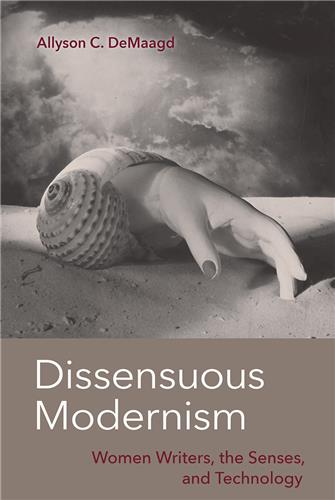
Dissensuous Modernism: Women Writers, the Senses, and Technology

BY ALLYSON C. DEMAAGD


UP of Florida, 2022

ISBN: 9780813069166

https://upf.com/book.asp?id=9780813069166


Placing women writers at the center of the sensory and technological experimentation that characterized the modernist movement, Dissensuous Modernism shows how women of the era challenged gendered narratives that limited their power and agency and waged dissent through their radical sensuous writing.  

BOOK NEWS is an online-only feature announcing new publications in modernist and contemporary literary studies. These announcements do NOT constitute an endorsement by the Journal of Modern Literature.

Allyson DeMaagd critiques an overemphasis among modernist writers and generations of researchers on the “masculine” senses of sight and sound, shifting the conversation toward the “feminine” senses of smell, taste, and touch. These senses, long considered “lower,” were explored by writers such as H.D., Mina Loy, Virginia Woolf, and Elizabeth Bowen, as DeMaagd demonstrates through detailed close readings of their lesser-studied novels. DeMaagd’s analysis shows how these women incorporated technology in their work to reunify the senses or to draw attention to the destructive disunity of the senses, highlighting the subversive potential of sensory integration.            

Dissensuous Modernism illuminates how modernist women writers breached the sensory borders society erects between men and women, heteronormativity and queerness, ability and disability, technology and nature, and human and nonhuman. It elevates diverse embodied experiences and illuminates the pivotal role of women in modernist sensory thought.  

“DeMaagd’s timely study examines the changing sensescape in modernist aesthetics and gives the long-denigrated ‘lower’ senses of smell, taste, and touch their interpretive due, not only uncovering the gendering of sensory experience but also demonstrating the extent to which sensory practices crucially involve questions of class, sexual orientation, (dis)ability, and species.”—Vicki Tromanhauser, SUNY New Paltz  

“Redressing the focus on visual senses that has dominated discussions of modernist (usually male) writers, Dissensuous Modernism argues that these modernist women writers call upon the underacknowledged senses of touch, feel, and smell in questioning gendered hierarchies of embodied and institutional power.”—Linda A. Kinnahan, editor of A History of Twentieth-Century American Women’s Poetry  


Allyson C. DeMaagd is an independent scholar and college success manager at Mid-Shore Scholars.